Automate or augment? The human-machine choice
The most important AI decision is not whether a task can be automated. It is what human capability must grow when the machine joins the work.
A machine can finish a task before its human colleague has framed the question. That speed is seductive. But if the task was the place where someone learned to notice a problem, defend a judgement or earn another person's trust, what exactly have we saved? The answer begins with a distinction too often buried in the pitch for AI: automation transfers execution; augmentation expands human capability.
The false choice in the boardroom
Imagine a leadership meeting weighing two proposals. One promises to let an agent process every request from start to finish. The other gives staff a system that gathers evidence, flags exceptions and leaves the consequential call with a person. Both may use similar technology. They distribute responsibility, learning and risk very differently. This meeting is hypothetical; the distinction is the argument of the source research.
In ‘Automate or Augment?’, Professor Amandeep Sidhu describes automation as the transfer of an end-to-end task to a machine with little or no real-time intervention. Augmentation, by contrast, supplies analysis and breadth while preserving human agency and final decision authority. Neither is inherently virtuous. The useful question is what kind of work is being redesigned, not how much AI is visible in it.
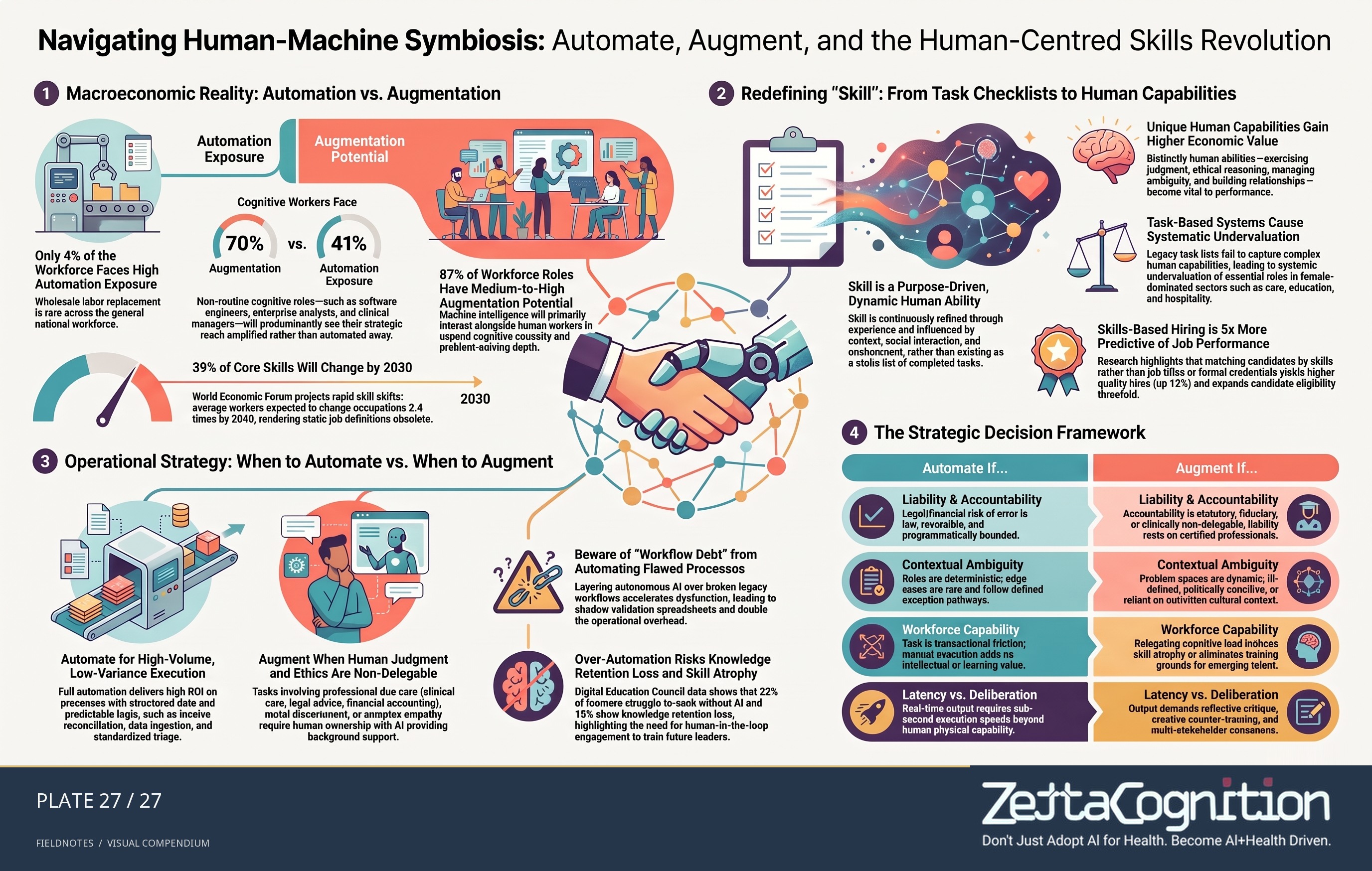
Read the Compendium plate as a decision map, not a verdict. Its two lower paths show where structured repetition might be automated and where ambiguity, care and accountable judgement call for augmentation. The percentages on the plate come from the source materials and are not independently verified here.
Put repetition on the machine's side
Straight-through processing fits a narrow, repeatable task with defined inputs, clear limits and a path for exceptions. The source points to data ingestion, invoice reconciliation and routine triage as examples. An automated system can handle volume, while a person reviews what does not fit the pattern. That is a workflow choice, not a claim that every invoice or customer request is risk-free.
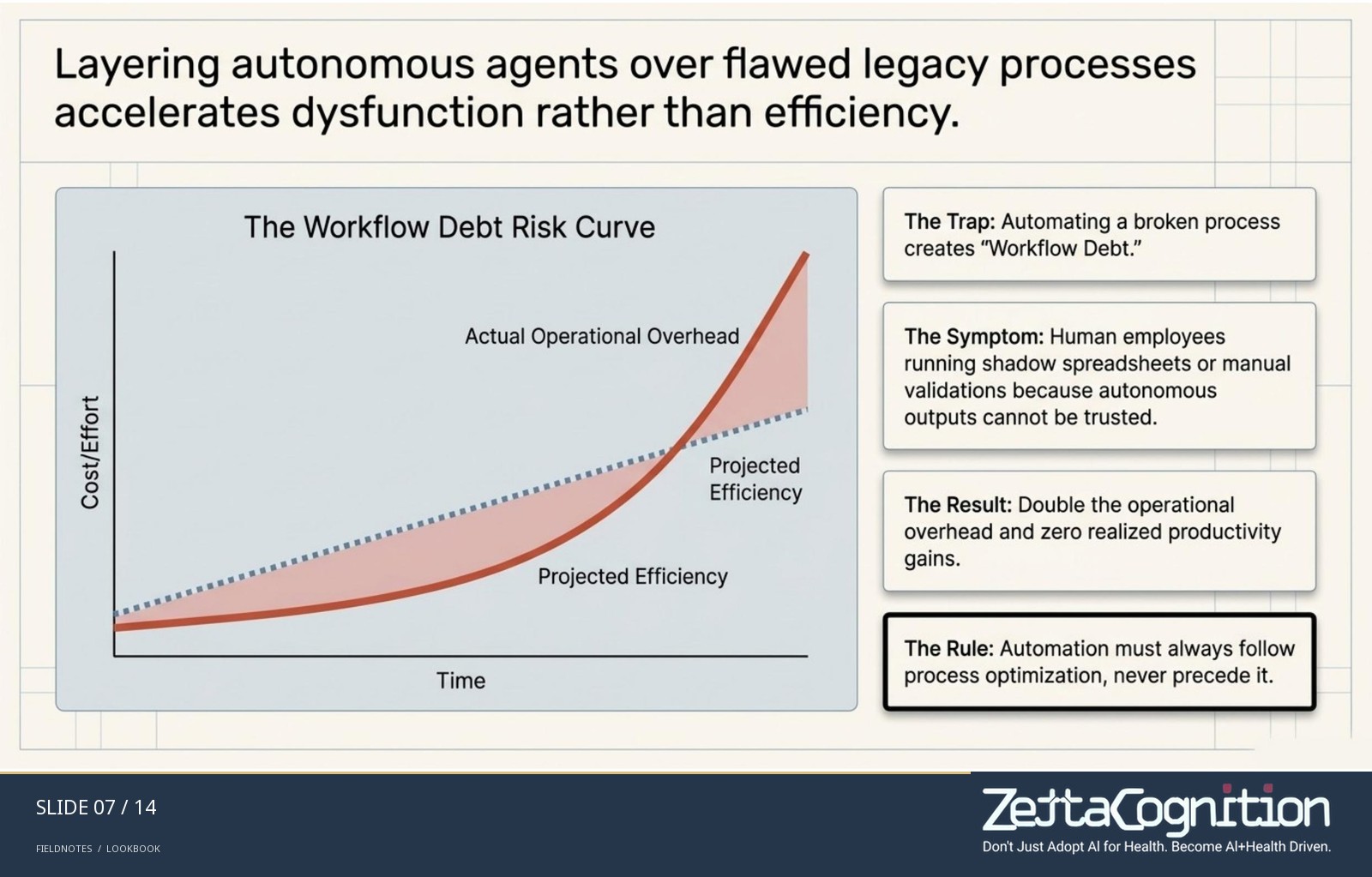
There is a catch: an old process does not become a good one because it moves faster. The research calls the accumulated burden ‘workflow debt’—the shadow spreadsheets, repeated checks and manual repairs people create when an agent sits on top of a broken handoff. Before automating, map the process people actually use. If they do not trust the output enough to stop double-checking it, the productivity gain exists only on the slide.
The comparison below brings that map down to a working choice. The boundary depends on the task's variance and stakes—and on whether a person can genuinely question an output before it matters.
Where should the decision sit?
Protect the work that develops judgement
Now move from an invoice to a clinical conversation, a complex legal explanation or an academic decision about a student's progress. Here context, empathy and accountable judgement are part of the work itself. AI might surface relevant information or expose an inconsistency, but the professional must be able to question it, explain the decision and own its consequences. The source names these as reasons to augment rather than automate; specific legal duties must be checked in the relevant profession and jurisdiction.
This is also a question about tomorrow's expertise. A junior colleague who only approves polished outputs may never practise the reasoning that lets a senior colleague catch a subtle error. The research calls this danger epistemic substitution: the appearance of knowing replaces the difficult work of knowing. Good augmentation asks the human to compare possibilities, articulate uncertainty and sometimes disagree with the machine.
Make the division of labour visible
The accompanying Human-Machine Symbiosis graphic sets the two modes side by side. Its decision filters contrast low-variance execution with contextual ambiguity, short latency with deliberation, and bounded liability with decisions that must remain attributable to people. The diagram is a strategic illustration—not an independently validated allocation rule or a legal compliance matrix.
A team can make that illustration operational by naming a decision owner, documenting what the machine may do without approval, defining the exceptions it must raise and checking whether people retain enough practice to spot a bad answer. A human ‘in the loop’ is not meaningful if the loop provides no time, information or authority to say no.
From prompt users to orchestrators
The slide deck calls for a more demanding role than simply typing prompts: people who design the handoffs, interrogate reasoning, watch for drift and revise a workflow when its evidence changes. It is an architectural argument with a human centre. Automation can release time, but only an organisation can decide whether that time returns as better service, stronger learning or merely more output.
The symbiotic goal is not a perfect division of tasks written once and framed on a wall. It is a practice of revisiting the boundary. When the task changes, the model changes or the people doing the work lose confidence, the boundary should be reconsidered. Efficiency without judgement is brittle. Judgement without the benefit of well-designed tools can be unnecessarily slow. The work ahead is to build the space between them.
The Lookbook slide names the danger of workflow debt: when agents are layered over a flawed process, workers build workarounds to survive it. The depicted curve is conceptual, not a measured forecast of costs.
Before asking how much work AI can take away, ask which parts of the work make people better at doing it—and design so those parts survive.