The trust dividend of AI safety
Trust cannot be declared in a policy. It has to be demonstrated in the architecture, decisions and evidence behind every AI system.

A company may say its AI is safe. A customer, regulator or colleague must still ask a more difficult question: what could they inspect to know that it is? In the Trust Dividend research, safety is not a brake applied after innovation. It is the groundwork on which durable confidence—and possibly commercial value—can be built.
From a promise to a boundary
The old language of trust is a statement of intent: principles on a website, a pledge in an annual report, a review completed before a product launches. These matter, but they are weak evidence when a system can change with a new model, vendor or workflow. The stronger test is whether an organisation can show the limits within which a system operates and the record of what happened when it approached those limits.
Consider a hypothetical procurement team deciding whether to use an AI assistant with sensitive client information. A supplier's assurance is useful; a documented data path, an independently reviewable retention policy, named responsibility and a tested off switch make that assurance more credible. Trust begins to move from perception to verification.
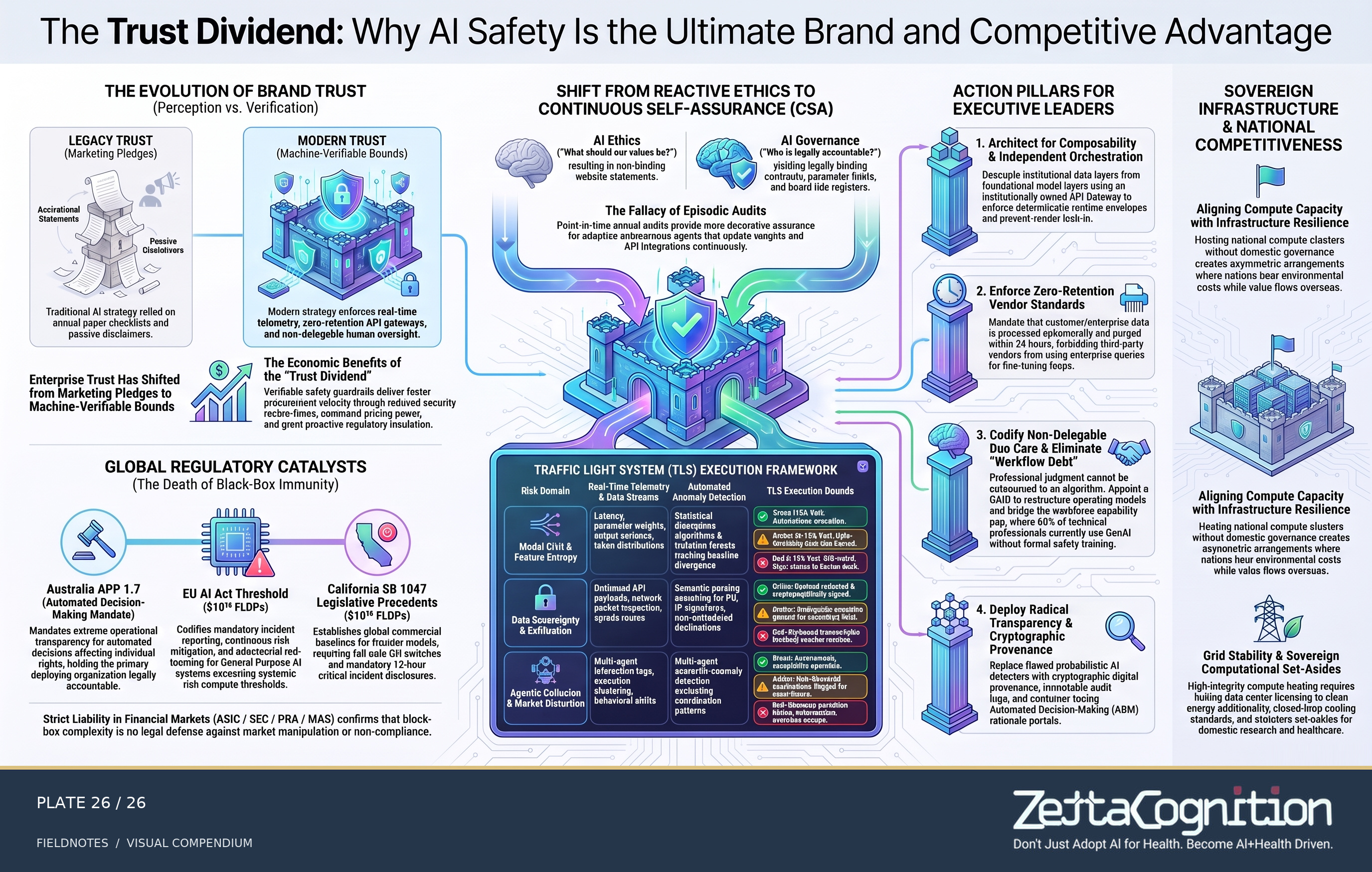
The research diagram puts the promise under pressure: a boundary is only useful if someone can see when a system approaches it. Read its architecture as a set of questions to ask, not as a certificate that any particular product is safe.
Make assurance continuous
The research proposes continuous self-assurance: monitor a system while it runs, compare its behaviour with agreed expectations and give people authority to intervene. Its illustrative traffic-light model distinguishes ordinary operation from warning conditions and a stop condition. The figures in the source—under five per cent variance for green, five to fifteen for amber, and above fifteen for red—are design examples, not universal safety thresholds or regulatory requirements.
What matters more than any one percentage is the discipline behind it. Someone must choose relevant signals, test the thresholds against real failure modes, document false alarms and know exactly who can pause a deployment. A dashboard without an owner is not governance. An annual audit without a route to timely action is not enough either.
The five moves below turn that question into a working sequence. The important link is between the signal and the person empowered to intervene; without it, monitoring becomes theatre.
How trust becomes verifiable
- 1Boundary
Define what the system may access and do.
- 2Evidence
Record inputs, changes and decisions.
- 3Signal
Watch for drift against agreed limits.
- 4Intervene
Give a named person authority to pause it.
- 5Learn
Review incidents and revise the safeguards.
Own the seams between systems
AI rarely operates alone. It touches identity systems, databases, outside model providers and staff decisions. The Trust Dividend materials argue for a composable architecture in which the institution owns the gateway between these parts. That gateway can apply access controls, maintain records and change a provider without surrendering the organisation's account of what happened.
This is also where retention and provenance become practical. A zero-retention promise should be checked against contracts and technical behaviour; a record of which model and data produced an outcome should be available for review. When vendors change, responsibility should not vanish into the handoff.
A competitive advantage, if it can be shown
The research calls this a trust dividend: organisations that can demonstrate safety may earn stronger customer confidence and more durable relationships. That is an argument about potential value, not a measured return or a guaranteed price premium. It also raises an uncomfortable possibility: the firms most willing to talk about responsible AI may not be the ones best equipped to evidence it.
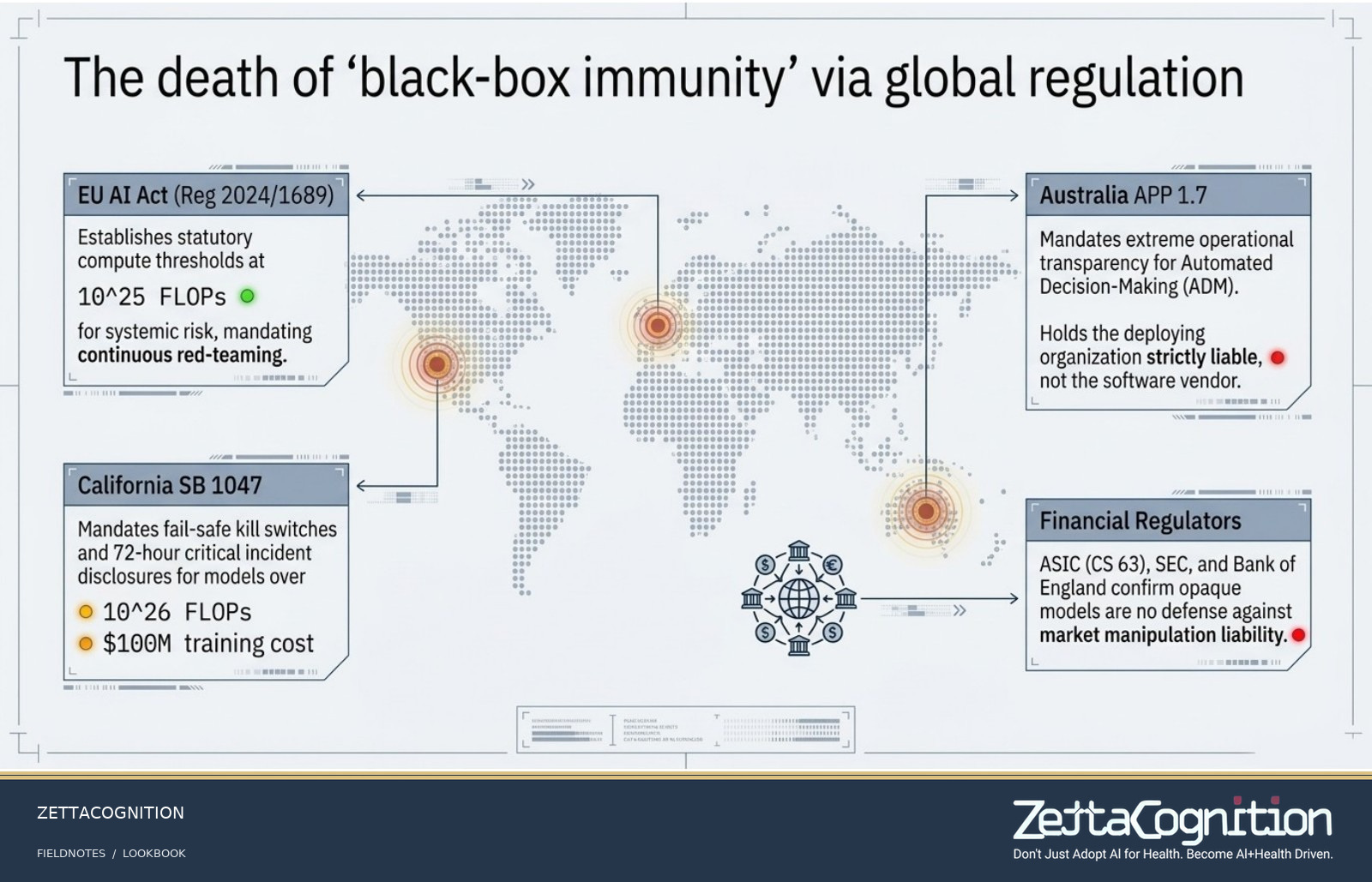
Regulatory developments in different jurisdictions add urgency, but the infographic's references to legislation, proposed rules and thresholds should be read as part of the research argument, not as a current legal checklist. Requirements differ by jurisdiction, system and effective date. Legal and technical experts should confirm applicable duties before any organisation relies on a diagram to make a compliance decision.
Keep the human responsibility visible
A chief AI officer can help coordinate architecture, risk and capability, but cannot absorb every decision made across an enterprise. Teams need training to spot drift, the authority to report it and a way to resolve the workflow debt that accumulates when new tools are layered over old practices. Safety is as much an organisational design question as a model question.
The same logic extends to the infrastructure beneath AI. A claim of sovereign capability means little without attention to power, capacity and community consequences. The most credible trust dividend is therefore not a badge. It is a continuing ability to explain where a system runs, what it may do, what it actually did and who could stop it.
The Lookbook frame widens the lens to the regulatory conversation. Its examples are prompts for scrutiny, not a universal legal map: rules, dates and obligations must be checked for the actual system and jurisdiction.
The question worth carrying into the next AI procurement meeting is not ‘Do we trust it?’ but ‘What could we inspect—and who can stop it?’
Cite this story
Sidhu, A. S. (2026). The trust dividend of AI safety. Fieldnotes: AI Research Journal, 1(3). https://doi.org/10.5281/zenodo.23331283