Care without the rescue narrative
When older people are framed as problems to optimise, even well-meant technology can diminish their agency.

The language used to sell aged-care technology often begins with crisis: too many older people, too few workers, too much risk. That framing can erase the people it says it will help.
Whose problem is being solved?
Imagine a resident who likes to walk in the garden each afternoon. A monitoring system might interpret movement outside a usual pattern as a risk. The alert could be useful, but if the response is simply to restrict movement, a measure introduced in the name of safety may diminish the life it was meant to support.
That tension is easy to miss when a proposal begins with institutional shortages and ends with a promise to optimise residents. Older people are not passive sites of risk. They have preferences, routines and the right to be involved in decisions about their own care.
Workers can help interpret the context behind a signal. They may know that a change is meaningful or that it reflects a welcome new habit. Their knowledge is not an anecdotal exception to the data; it is part of the evidence needed to use the data well.
Families, too, may welcome reassurance while disagreeing about surveillance. Clear consent and an opportunity to revisit it matter more than a one-time signature at admission.
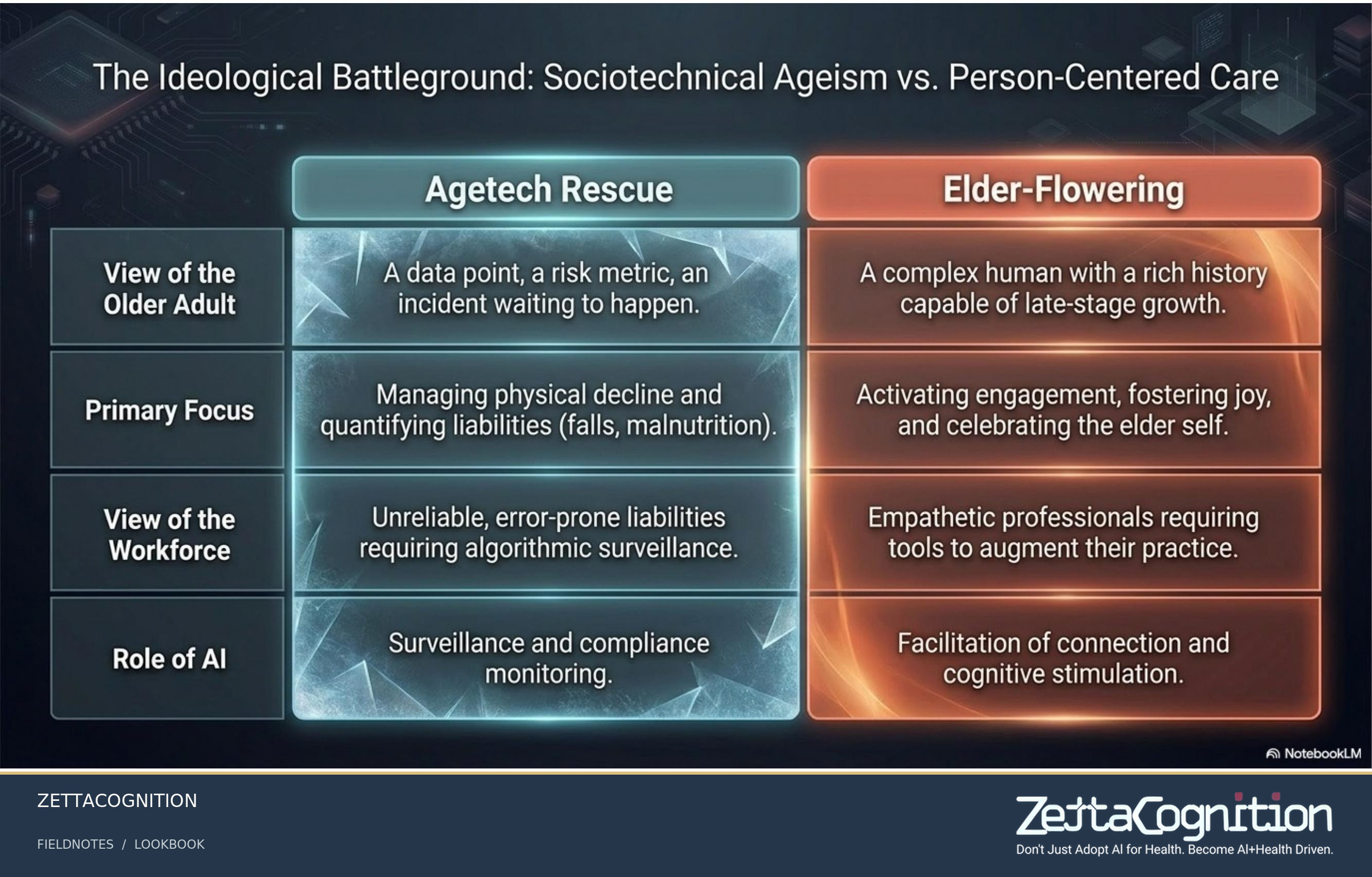
The person-centred care slide puts relationships ahead of the monitoring system. A resident cannot be reduced to a risk to be managed.
Design for a life, not a dashboard
A care technology should have a defined purpose and a way to tell whether it helped the resident on their own terms. Preventing an incident may matter greatly, but so may preserving independence, comfort and the relationships that give a day its shape.
This can mean choosing less monitoring, not more, when a person’s wishes and circumstances call for it. It can mean allowing a worker to document why an alert was not followed. Systems that cannot accommodate these decisions are not neutral; they carry a particular idea of care.
The alternative to a rescue narrative is not indifference to strain in aged care. It is to address that strain while respecting older people as participants in the solution, never merely the subjects of it.
The two framings below lead to different designs. One asks how to contain risk; the other asks how to preserve choice, dignity and a life worth living.
Reframing care
More than a risk profile
Monitoring may detect a fall, but it cannot tell the full story of a person’s preferences, routines or relationships. Reducing care to incidents encourages institutions to value only what is easy to count.
Older adults and their families should have a say in what is monitored and why. Workers should be able to explain when an alert conflicts with what they know about a resident.
Ask a better question
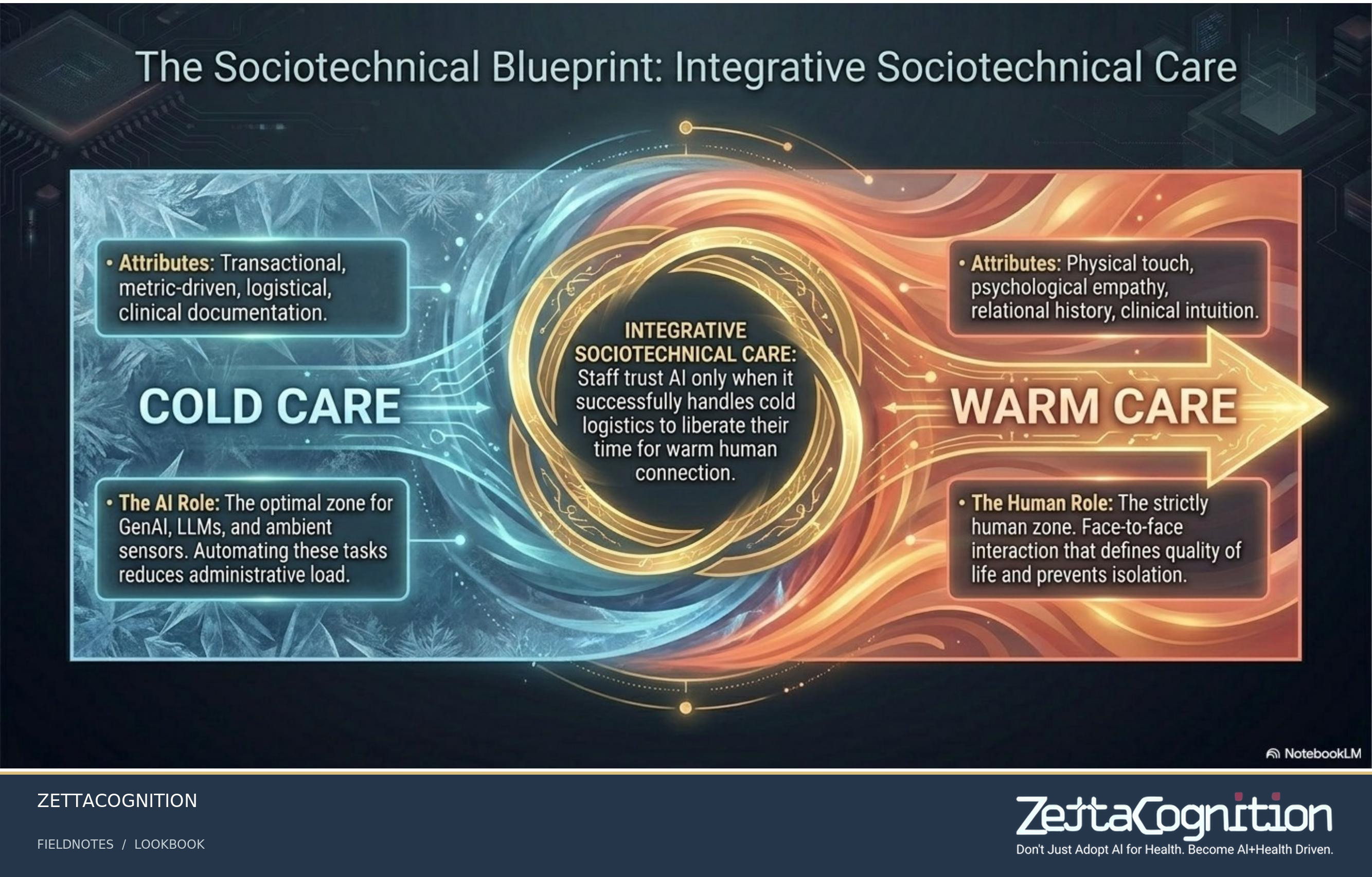
The question is not whether a system can replace human attention. It is whether it helps staff give more attentive care without making residents feel watched rather than known.
A technology earns its place when it supports a person’s life, not when it makes that life legible to a dashboard.
The next slide contrasts a technology-led cold-care path with warm care. These are illustrative design choices, not measured outcomes; the response must be shaped with older people and care workers rather than imposed upon them.
A better care system is not one that watches people more efficiently. It is one that knows whose life the watching is meant to serve.
Cite this story
Sidhu, A. S. (2026). Care without the rescue narrative. Fieldnotes: AI Research Journal, 1(2). https://doi.org/10.5281/zenodo.23329089