The missing bridge between skills and jobs
A workforce can have talent in the wrong places while employers report shortages. Better pathways matter as much as more training.

When people change occupations, they rarely start from zero. Yet credentials and hiring systems often describe work in ways that make transferable capability hard to see.
A career change on paper
A hospitality worker may know how to defuse tension, coordinate a team and notice when someone needs help. A care employer may need precisely those abilities, yet a job advertisement written entirely in sector-specific terms can make the transition look impossible. The barrier is not always missing capability; sometimes it is missing translation.
A skills map can show overlap, but it must also show what is genuinely new. Care work, for example, carries technical requirements, responsibilities and conditions that cannot be waved away with a list of transferable skills. Honest pathways name the distance between roles rather than pretending it is zero.
For someone considering a move, the decisive questions are practical: how much training, at what cost, on what schedule, and with what income in the meantime? A promising pathway that ignores these constraints is more invitation than bridge.
Employers have work to do as well. If hiring systems filter by an exact job title before assessing evidence of capability, they can miss people with adjacent experience and a realistic route to readiness.
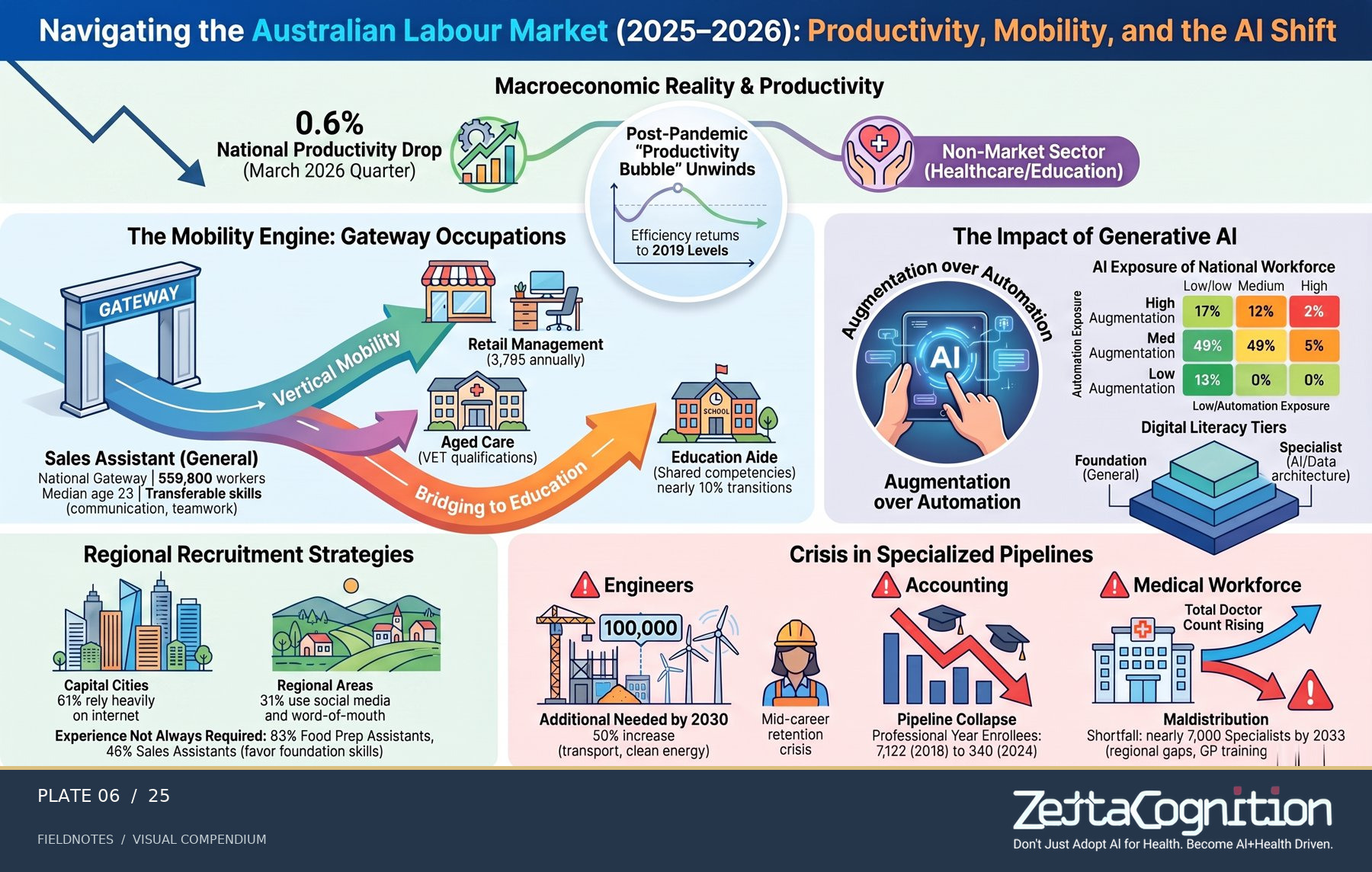
The labour-market plate reveals why a skills map can be both promising and misleading. Shared capabilities show possible crossings; licensing, pay and actual vacancies show whether the bridge reaches the other side.
Make the crossing real
Recognition of prior learning can reduce unnecessary repetition. Short, targeted education can address the remaining gaps. Supervised experience can let a person demonstrate the new capability in context while giving an employer confidence in the transition.
These steps require coordination among educators, employers and workers themselves. The worker should be able to see why a skill was recognised, which requirements remain and how progress will be assessed. Transparency turns an abstract opportunity into a plan.
A labour market works better when it can recognise what people bring with them and invest in what they still need to learn. Mobility is not frictionless, but it can be far less wasteful than asking every person to start again.
The four steps below connect a demand signal to a real role. Skip recognition or placement and training can end in another credential with nowhere to go.
Bridging skills and jobs
- 1Signal
Track employer demand.
- 2Learn
Offer short, stackable training.
- 3Recognise
Credit skills people have.
- 4Place
Connect to real roles.
Make adjacent skills visible
A worker moving from hospitality to care, or administration to digital operations, may already possess communication, coordination and judgement that the new role needs. A map of shared skills can reveal plausible transitions.
Such maps should be tested against real jobs, wages and training requirements rather than promising frictionless moves that do not exist.
Support the crossing
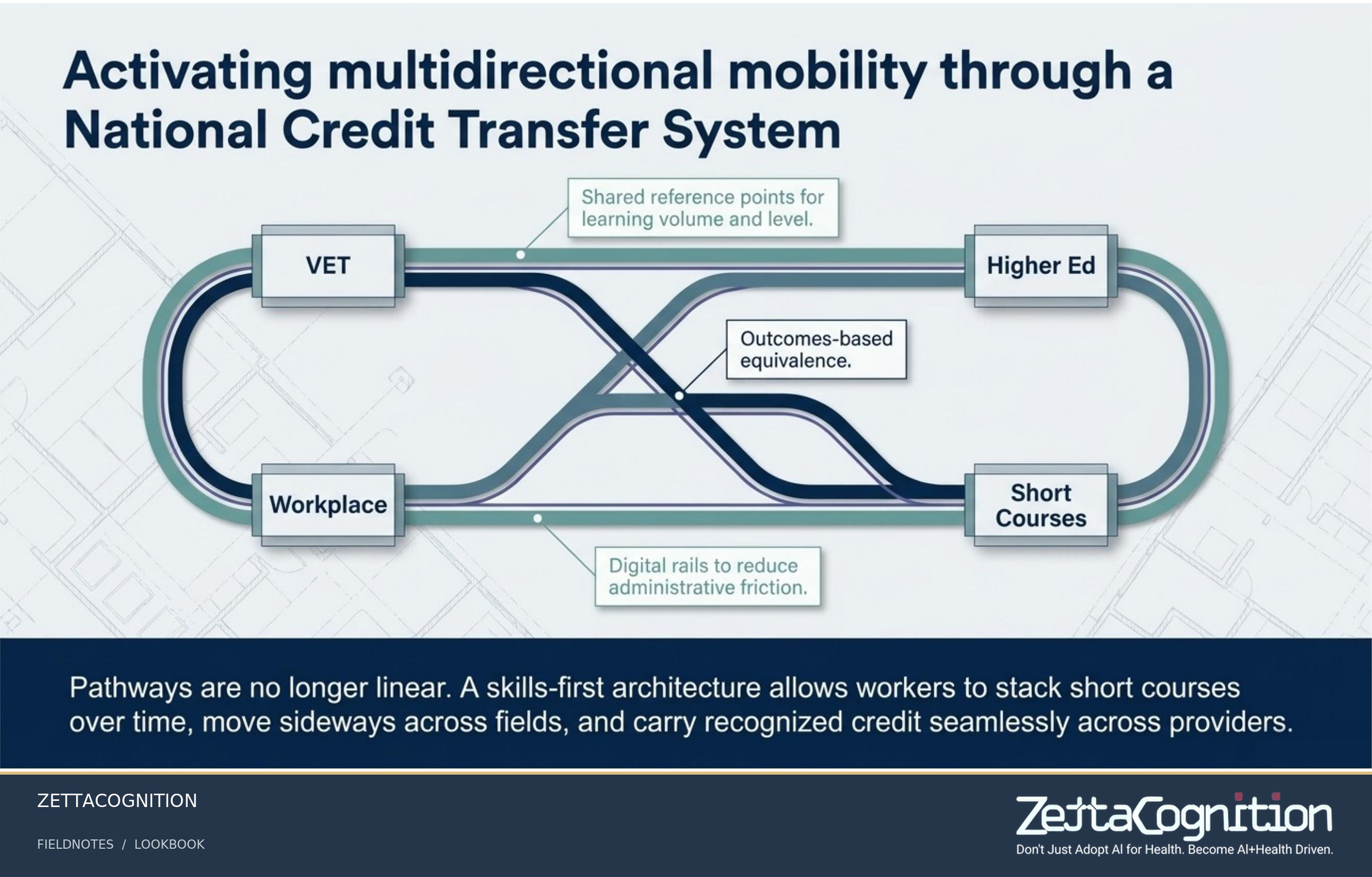
Short courses, recognition of prior learning, supervised experience and employer participation can turn a possible pathway into an achievable one. Without them, an elegant skills diagram remains a diagram.
Productivity gains are more likely when people can move toward meaningful work without having to abandon everything they have learned.
Not every bridge carries the same traffic
In his AI Thought Fog analysis of Australia’s labour market, Professor Sidhu contrasts accessible entry roles, such as sales assistant, with the more regulated routes into clinical medicine. The first can open onto many directions; the second requires specific training and licensing. A map of transferable skills must not confuse the two.
The analysis also distinguishes potential for AI to augment work from wholesale automation. This changes the planning question: not simply which jobs disappear, but where people can use new tools, where professional rules constrain movement, and what training makes a transition credible.
The skills-economy slide broadens that crossing from one worker to a whole system. Its pathways need to be tested against real requirements, not treated as guaranteed moves.
The most useful labour-market question is not ‘What job is disappearing?’ but ‘What credible next step can this person actually take?’
Cite this story
Sidhu, A. S. (2026). The missing bridge between skills and jobs. Fieldnotes: AI Research Journal, 1(1). https://doi.org/10.5281/zenodo.23328315