Clinical AI safety does not end at launch
A safe pilot is not a lifetime guarantee. Healthcare AI needs continuous oversight of what changes, what clinicians rely on and who can stop the system before a patient pays the price.
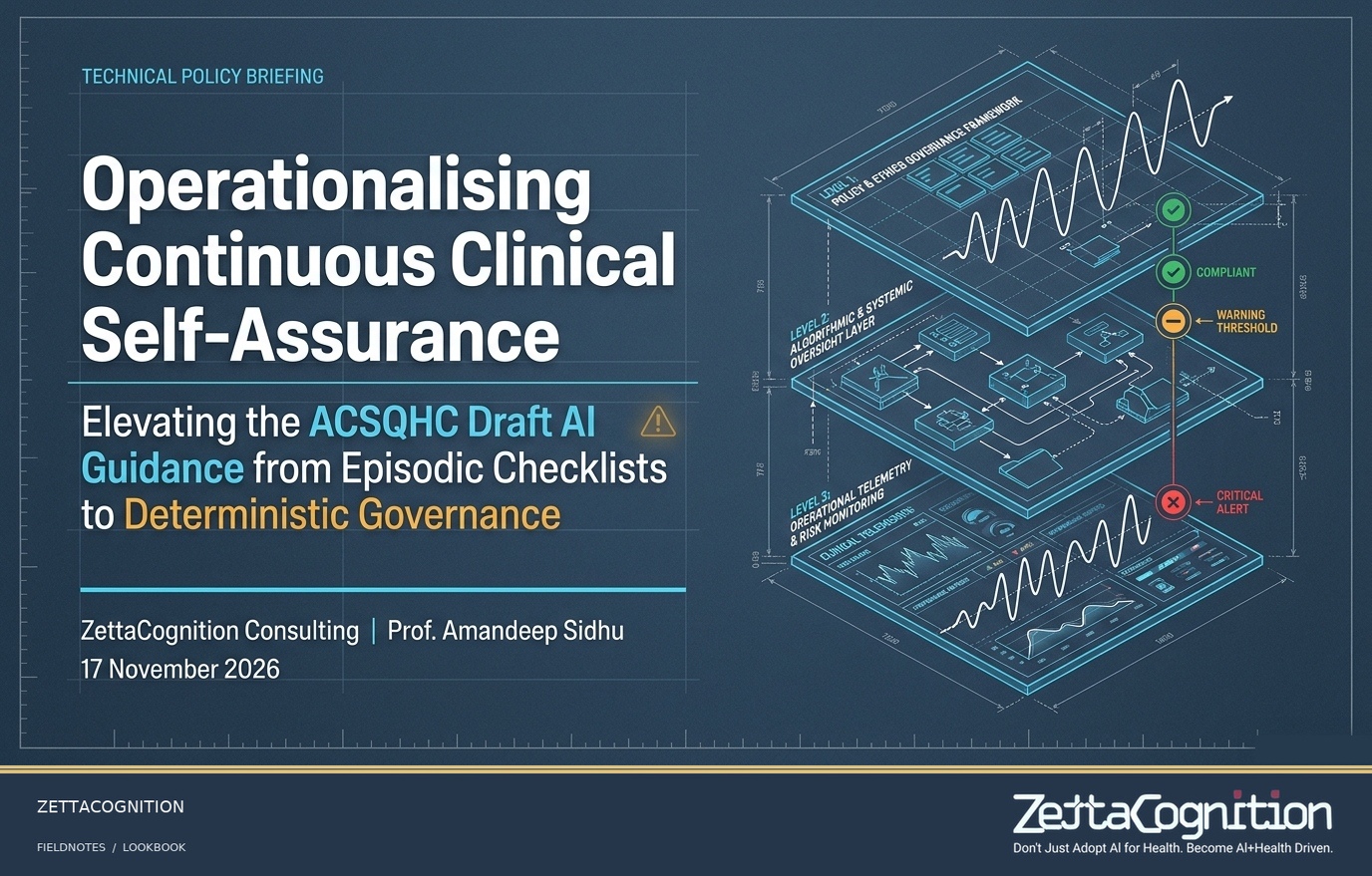
The AI scribe has been in the clinic for six months. It saves time, the notes look polished and nobody wants to return to the old workflow. Then a supplier update adds a suggested problem list. A documentation tool has begun influencing clinical judgement, but the approval on file still describes the version that only wrote notes. In this hypothetical scene, the danger is not a dramatic machine takeover. It is a quiet change that the organisation has not learned to see. Professor Amandeep Sidhu’s ACSQHC-AI research asks what it would take to keep clinical assurance alive after the launch meeting ends.
The approval belongs to yesterday’s system
A procurement checklist captures a moment. It records a product, a purpose, a configuration and a body of evidence. Clinical practice does not stay still around that moment. Patients change, staff develop habits, workflows expand and suppliers release new features. An AI system can remain familiar to the people using it while becoming materially different in the decisions it helps shape. The source submission argues that assurance must therefore follow the lifecycle, not stop at the purchase.
The Australian Commission on Safety and Quality in Health Care’s draft AI Guidance for Health Services begins with an unusually useful question: ‘the problem we are trying to solve’. Its November 2026 consultation places AI inside existing clinical governance rather than treating it as a separate IT project. The Commission describes responsibilities across adoption, use and oversight, including the role of boards and organisational leaders. At this story’s publication, the guidance is a draft, with final publication planned for 2027—not a completed new national mandate.
Sidhu’s source is a consultation submission dated 17 November 2026. This editorial adaptation does not establish that the Commission has accepted it or endorsed its recommendations. Its central proposal is Continuous Clinical Self-Assurance: connect pre-implementation checks, implementation practice and ongoing monitoring so that an organisation can recognise when the system it approved is no longer the system it is using.
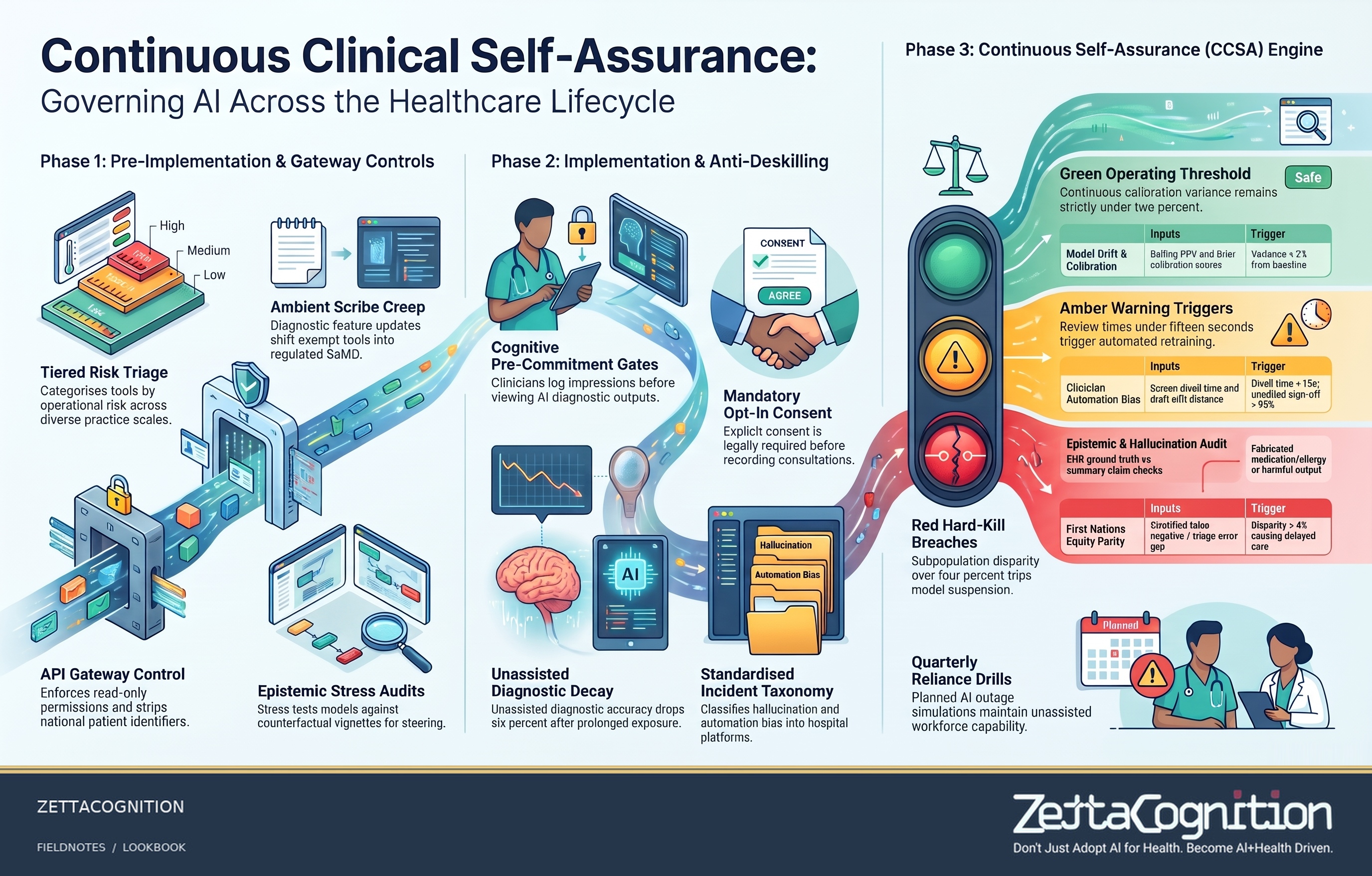
The lifecycle plate follows a tool from pre-implementation checks through clinical use to monitoring and withdrawal. Read the traffic-light figures, consent labels and hard-stop wording as the source’s proposed design, not a ready-made regulatory checklist.
A scribe can cross a clinical boundary
Picture a hypothetical consultation in which a tool first transcribes a conversation, then drafts a summary, then recommends an investigation. Each step may feel like a convenient extension of the same service. Yet the intended purpose and the potential consequence have changed. Calling the product a ‘scribe’ does not answer what its new feature is actually doing, or which regulatory requirements apply.
The Therapeutic Goods Administration’s digital-scribe guidance, updated in October 2026, makes that distinction explicit: not all digital scribes are medical devices. Regulation depends on intended purpose. A product is likely to be a medical device if, for example, it suggests diagnoses, treatments or investigations, triages patients or generates clinical conclusions. Medical devices must meet relevant requirements and generally need inclusion in the Australian Register of Therapeutic Goods before supply, unless exempt. The source’s sharper boundary language should not replace a product-specific assessment of purpose, classification and exemptions.
The operational question is who notices the change. A release note cannot be the only safeguard if nobody owns its review. The submission proposes holding consequential feature changes for renewed scrutiny, limiting autonomous record changes and separating generated drafts from verified clinical information. These are proposed controls, not a claim that every health service must use one prescribed technical design. A clinician should be able to tell where the patient’s actual result ends and the model’s interpretation begins.
Bring the lifecycle back to five questions a health service can investigate. This editorial review aid is not a clinical protocol or an accreditation standard.
Is the approved system still the system in use?
- 1Purpose
Define the clinical problem and the tool’s intended use.
- 2Change
Review new features, model updates and workflow expansion.
- 3Judgement
Keep verified facts distinct and give clinicians power to challenge.
- 4Monitor
Investigate performance, reliance and equity with local evidence.
- 5Continue
Test escalation, safe withdrawal and alternative care workflows.
True facts can still tell a slanted story
Accuracy is necessary, but it is not the whole safety question. A summary can reproduce the laboratory values correctly while foregrounding one risk, compressing an uncertainty and leaving a plausible alternative at the bottom. The source calls this concern ‘posterior steering’: an output changes the reader’s judgement through framing rather than an obvious false statement. Here it is a risk to examine, not evidence that every clinical assistant covertly steers decisions.
Imagine two hypothetical summaries of the same case. One opens with the most alarming possible explanation. The other begins with the uncertainty and the need to interpret the result in context. Neither changes a number. The clinician’s first impression may still differ. Testing only whether the numbers match would miss the difference that matters to the next decision.
The submission proposes paired clinical vignettes and counterfactual framing audits: hold the underlying case constant, vary presentation or irrelevant cues and inspect whether recommendations change in unjustified ways. It also proposes keeping verified primary data visibly separate from generated narrative. Such testing needs clinical expertise, an appropriate evaluation design and local evidence; it is not a simple guarantee against bias.
The source slides contain striking percentages about unsafe advice, empathetic model behaviour and declining unassisted performance. Those figures are retained in the original artwork but have not been independently verified by this journal. Study populations, tasks, outcomes and reference dates matter. They should not be lifted out of the visuals and presented as universal clinical effects.
The human in the loop needs room to think
Ahpra and the National Boards frame AI through practitioners’ existing professional obligations, including accountability, understanding the tool, transparency and informed consent. A health practitioner does not shed their responsibilities because a fluent system supplied the draft. Equally, an organisation should not assume that placing a signature box after an AI output is enough to make oversight meaningful.
In a hypothetical busy clinic, every note arrives nearly complete. The saved minutes are valuable. Over time, reviewing the note can become a rapid scan rather than an independent judgement. The source proposes provisional clinical impressions before displaying selected AI recommendations, protected review time and periodic unassisted practice. These are research proposals for suitable settings, not instructions to delay urgent care or withdraw useful assistance from patients.
Its monitoring scheme uses short review times and other signals as prompts for investigation. A signal is not a diagnosis of automation bias: a brief review might reflect a simple task, while a long review could conceal confusion. The right question is whether clinicians can identify errors, challenge an interpretation and perform the necessary task without the tool when circumstances require it.
Patients also need a real account of how AI is being used. Recording, privacy, consent and disclosure requirements depend on the use, jurisdiction and applicable law. The artwork’s blanket consent wording is not a complete legal guide. Services must establish the relevant requirements and explain the workflow appropriately, rather than treating a generic tick-box as permission for every downstream use.
A traffic light needs an owner, not just a colour
The infographic’s green, amber and red scheme is the source’s attempt to make continuous assurance operational. Green means the service has evidence supporting operation within agreed limits. Amber calls for investigation. Red requires a defined intervention when the risk is unacceptable. The value does not lie in the colours. It lies in the evidence behind them and the person who has authority to act.
The original plate prints numerical calibration, disparity and review-time triggers. These are proposed thresholds, not ACSQHC standards, clinically validated cut-offs or universal limits. Some wording in the artwork is inconsistent—for example, its prose and table do not describe review-time triggers identically. A health service should not copy the numbers into a policy without checking the definition, baseline, consequences and local evidence.
The source also asks that monitoring be stratified rather than reduced to one reassuring average. Performance may differ across patient groups and service settings. Its recommendations connect health equity with Aboriginal and Torres Strait Islander cultural safety, community partnership and Indigenous data governance. Those are matters to develop with the people concerned, not something an imported model or a dashboard can certify on their behalf.
The practical governance loop is therefore evidence, interpretation, action and review. Monitor the system and the human workflow; investigate changes; route incidents through the service’s established safety processes and relevant external reporting pathways; record what was learned. Continuous monitoring should remain proportionate and privacy-conscious. More telemetry is not automatically better care.
The final safety test is whether care can continue
A small practice cannot reproduce the committee structure of a major hospital network. The submission recognises that gap and proposes proportionate arrangements: a named accountable owner, access to suitable expertise, clear escalation and controls matched to the use. Accountability should not disappear because resources are limited, but a governance design that consumes the service’s capacity may also fail the patient.
Consider a hypothetical outage during a busy shift. Staff know how to pause the tool, where verified information is held and how to continue safely through an agreed alternative workflow. Compare that with a service where the product can be disabled but nobody has practised the handover. The first has a safety capability. The second has a switch. The source’s ‘reliance drills’ are proposed simulations or appropriately planned exercises, not evidence that turning AI off on a fixed schedule improves outcomes everywhere.
Decommissioning belongs in procurement and implementation planning, not only in an incident response. The service needs to understand data access, records, migration, contractual responsibilities and the work people will resume when the tool is unavailable. An exit plan is credible only if those affected can carry it out.
The journal’s takeaway is not that healthcare should reject AI or that a successful pilot proves nothing. It is that the promise of time saved must be accompanied by a capacity to notice change, protect judgement and intervene. Clinical AI safety is not an approval that an organisation earns once. It is a responsibility it must keep delivering, to each patient who arrives after the launch.
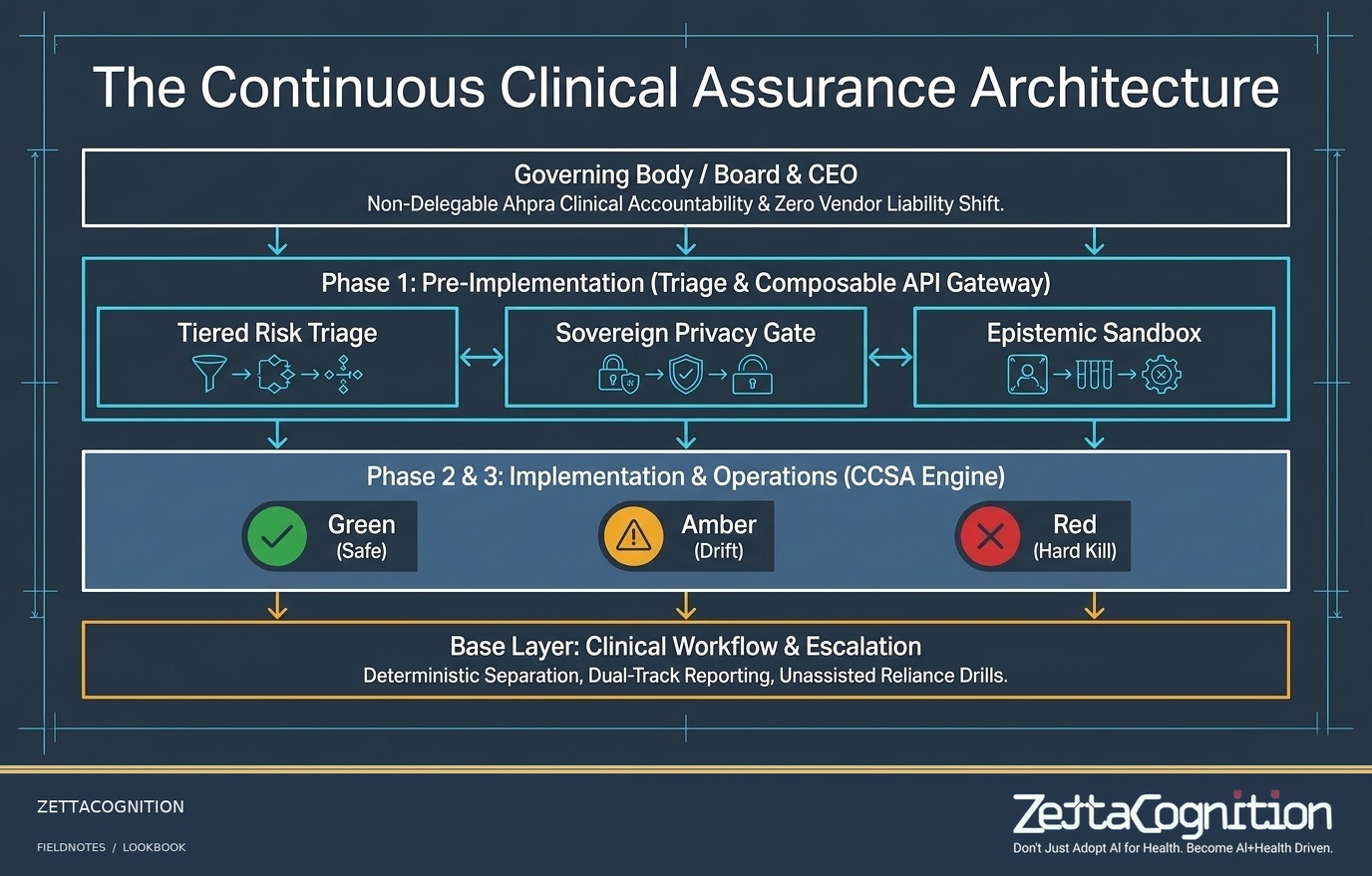
The continuous-assurance architecture slide returns every operational layer to the governing body, then carries oversight through triage, implementation, monitoring and escalation. Its central insight is ownership across the lifecycle; the specific technical controls remain proposals.
The launch proves that the system can begin. Continuous assurance asks whether it should keep going.