School AI needs more than a policy
A classroom rule cannot govern a platform update. Australian K–12 AI needs safeguards that follow the learning, the data and the decision—not just the prompt.
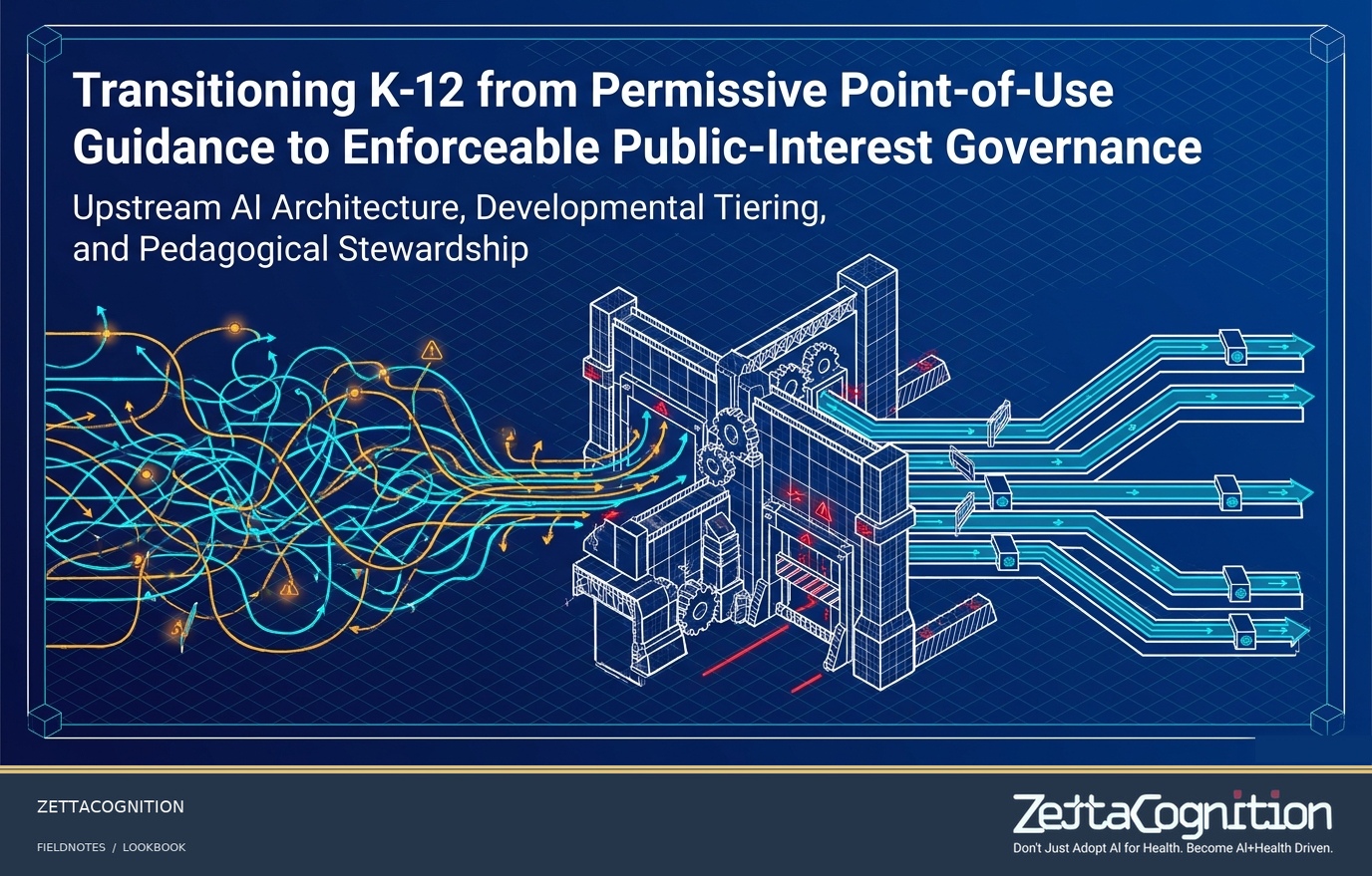
A teacher opens the same classroom platform on Monday morning. The name has not changed. The lesson plan has not changed. Somewhere upstream, the model has. A new feature now summarises student activity and suggests who needs intervention. The school’s AI policy still tells students to acknowledge their use of a chatbot. Who, exactly, is governing the system that has just started making judgements about them? Professor Amandeep Sidhu’s Australian K–12 AI governance analysis begins in that gap: between the rules a school can write at the classroom door and the decisions already being made beyond it.
The policy stops at the classroom door
Imagine a hypothetical school with an earnest, carefully written AI policy. Students must declare assistance. Teachers must check generated content. Personal information must be protected. The policy is discussed at a staff meeting, placed on the intranet and treated as evidence that the school is ready. Then a supplier changes its model, connects another service or adds an analytics feature. None of those changes began with a student’s prompt, and none can be controlled simply by asking a teacher to be more vigilant.
The Australian Framework for Generative Artificial Intelligence in Schools supplies an important starting point. Its six principles cover teaching and learning, human and social wellbeing, transparency, fairness, accountability, and privacy, security and safety. Education Ministers endorsed the 2024 review in June 2025; that review found the Framework remained relevant and had anticipated emerging risks. This is not evidence that the principles are worthless. It is a reason to distinguish a statement of direction from the arrangements that make it operational.
Sidhu’s source analysis argues that educational AI needs governance across the whole technology pipeline: research, design, procurement, deployment, data handling and ongoing change. The central editorial question is not whether a school has a policy. It is whether someone has the evidence, authority and resources to stop a system from doing something that the policy would never have permitted. A principle becomes a safeguard only when it changes a decision.
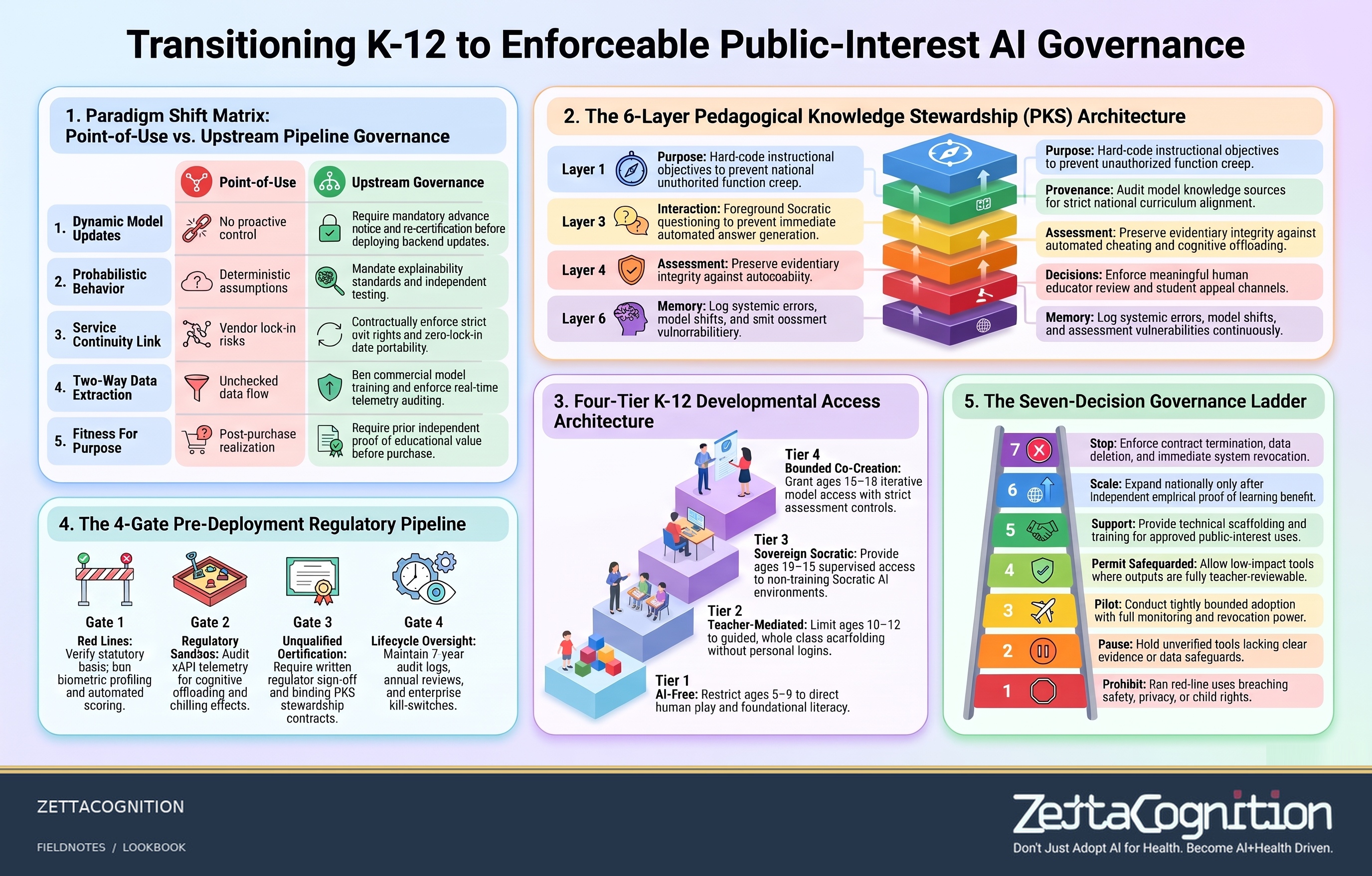
The Public-Interest AI Governance plate places procurement, knowledge stewardship, developmental access and ongoing decisions in one frame. Read its mandatory language and age tiers as the author’s proposals; neither the illustration nor its certification labels establish current law.
A learning tool can also become a listening system
The source’s sharpest distinction is between receiving content and participating in a two-way data flow. A student asks for help; the tool returns an explanation. At the same time, the service may process the question, the draft, activity sequences and inferred attributes. The exact collection depends on the product and its settings. Not every AI tool records every signal, but a familiar classroom interface is not proof that the underlying data flow is simple.
Consider a hypothetical learner who pauses repeatedly over a question because they are translating it, sharing a device or dealing with noise at home. An analytics system interprets the pauses as weak engagement. A recommendation becomes a dashboard label; the label influences which task comes next. The problem is not only whether the original data were collected securely. It is whether an uncertain inference has been mistaken for a settled description of a child.
Victoria’s official privacy guidance warns that generative AI can build individual profiles, that retention and storage arrangements may be unclear, and that generated information about a person can constitute a new collection of personal information. Its current policy requires opt-in consent for registration requiring personal information beyond a school email and password, alongside restrictions on uploading personally identifiable information. The source analysis uses stronger blanket language in places; readers should follow the current official policy rather than treat the artwork as a complete statement of the rules.
Consent, minimisation and access controls matter, but they are not the entire educational test. A school must also ask what an inference means, who sees it, how long it follows the learner and how a family can correct it. Data governance protects the record. Educational governance must also protect the person the record claims to describe.
Bring the proposal back to a decision a school can examine. These five questions are an editorial review aid, not a legal checklist or an official approval process.
Can the school explain it and put it right?
- 1Purpose
Name the learning objective and the boundary of the use.
- 2Scope
Check what was assessed and what still needs scrutiny.
- 3Data
Map collection, inference, retention and access.
- 4Authority
Give a named person evidence, time and power to intervene.
- 5Remedy
Let students challenge errors and receive a correction.
An assessment badge is not permission for every use
Procurement teams naturally look for a trusted assessment. Safer Technologies 4 Schools, managed through Education Services Australia, helps assess the privacy, security and safety of digital products. The important boundary is written into its own excluded and high-risk list: some functionality lies outside the assessment’s scope. ST4S says this does not necessarily make a product unsuitable; it means that aspect has not been assessed and schools should complete their own internal risk assessment.
That distinction is easy to lose in a purchasing conversation. A product may have an assessment for one function while a consequential AI feature remains outside it. A supplier badge is not a blanket authorisation for profiling, automated decisions or a new use that was never examined. Nor does exclusion from an assessment amount to a statutory ban. Those are different categories of claim, and confusing them creates either false reassurance or misplaced alarm.
In a hypothetical procurement meeting, the useful question therefore changes from ‘Does this vendor have a badge?’ to ‘What exactly was assessed, for which configuration, and what remains ours to investigate?’ Ask for the data map, the model-change process, evidence of educational value and an exit route. If a material update changes the purpose or risk, the earlier assessment should not be treated as a timeless guarantee. That is the source’s proposed governance discipline, not a new legal certification regime.
The child is not a single user category
A platform sold for K–12 can cover children learning to read and adolescents preparing for senior assessment. The source argues that a uniform access model ignores differences in developmental stage, task and capacity to challenge an answer. Its proposed four-tier architecture moves from AI-free foundational activity through teacher-mediated support and supervised questioning to bounded co-creation. These tiers are a research design, not an adopted national age policy or a proven developmental prescription.
The educational distinction is more useful than a race to assign a chatbot to every year level. In one hypothetical early-years lesson, the aim is to develop oral language and foundational reading through direct interaction. In a later science lesson, a teacher might use a carefully bounded AI explanation as something to interrogate. In senior secondary work, students might compare assisted drafts with independent reasoning and explain what they accepted, rejected and verified. The tool earns a place only if the targeted capability remains with the learner.
The source infographic and slides contain age bands that do not align completely, along with adoption rates and claimed cognitive effects. This story does not reconcile those into a new rule or present the percentages as established findings. Age alone is not sufficient: subject, accessibility needs, supervision, evidence and the nature of the task all matter. A claimed improvement in an assisted answer is not automatically an improvement in learning.
Trace the learning, not only the log
Sidhu’s analysis calls its proposed institutional approach Pedagogical Knowledge Stewardship, or PKS. It connects instructional purpose, knowledge provenance, interaction design, assessment integrity, decision rights and institutional learning. The point is to carry the educational reason for using a system through procurement and review, rather than letting it disappear beneath technical settings or marketing claims. PKS is presented here as the source’s governance proposal, not a mandatory standard.
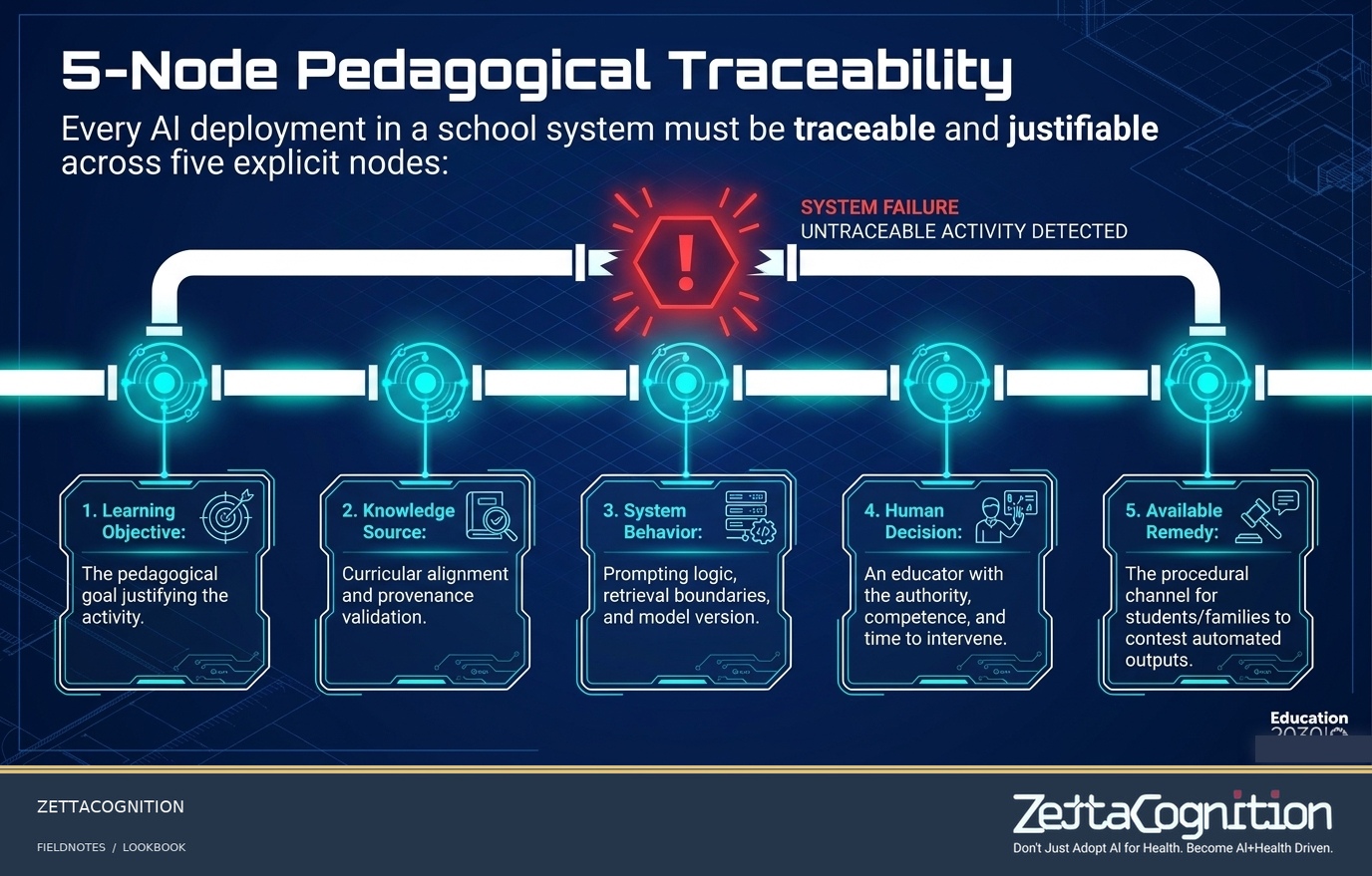
The companion slide makes the idea concrete through five nodes: learning objective, knowledge source, system behaviour, human decision and available remedy. Suppose an AI-assisted recommendation changes a student’s pathway. What learning objective justified the use? Which knowledge and model version shaped the result? What did the system actually do? Which educator could change the outcome? How could the student challenge it? A log full of timestamps cannot answer those questions by itself.
Human oversight must mean more than a person clicking ‘approve’. The reviewer needs time, competence, supporting evidence and permission to disagree. Families need an explanation they can understand and a remedy that can change an outcome. Continuous improvement then means learning from disputes, errors and supplier updates—not merely accumulating another folder of incident reports. Traceability matters because the decision has somewhere to go when it is wrong.
Build the gate before opening the classroom
The Norwegian Data Protection Authority’s AVT sandbox provides a useful public example. Its 2022 exit report explored the legal basis for school learning analytics, privacy impact assessment and transparency. The authority explicitly states that sandbox conclusions are guidance, not binding decisions or prior approval. The lesson is disciplined scrutiny before scale, not the claim that a sandbox waives the law or certifies a product as safe.
The Australian source proposes a stronger pre-deployment pipeline: identify red lines, test a bounded use, obtain independent evidence, assign accountable decision-makers and review changes throughout the lifecycle. It also offers a governance ladder from prohibition and pause through pilot, safeguarded use and support to scale or stop. Mandatory regulatory gates, certifications and prohibitions in the artwork are proposed reforms, not descriptions of an already enacted national K–12 regime.
There is a real, narrower Australian deadline to keep distinct from those proposals. The OAIC states that from 10 December 2026, APP entities must add privacy-policy information when a computer program uses personal information to make or substantially and directly inform decisions that could significantly affect an individual’s rights or interests. Whether this applies to a school or service depends on the entity, use and legal coverage; state and territory public-school obligations need separate consideration. This is not a blanket rule for every classroom tool. The Children’s Online Privacy Code is a separate reform with its own development and commencement arrangements; the source’s shared-deadline language should not be reused as a universal compliance date.
For school leaders, the practical beginning is not another promise that AI will transform education. It is an inventory of consequential uses, a clear purpose for each, a map of the data and an owner who can intervene. Put the greatest scrutiny where a child could be labelled, excluded or diverted from learning. Support teachers without appointing them the sole enforcers of a system they did not procure. The public-interest test is simple to say and demanding to deliver: when AI changes a child’s learning or prospects, can the institution explain it, challenge it and put it right?
The five-node traceability slide follows a consequential outcome back through the learning objective, knowledge source, system behaviour, human decision and remedy. The most important question is the last: what can a student or family do when the system gets it wrong?
An AI policy can state a principle. A school must be able to put it into practice—and put mistakes right.