Don't blame AI for the hiring freeze
Record employment can hide a cooling labour market. Before blaming AI for lost entry-level jobs, leaders need to separate the algorithm from interest rates, wages and geography.
A graduate sends out fifty applications and hears back from three. A headline tells them the reason: AI has taken the entry-level jobs. It is a tidy story, and it may be the wrong one. Professor Amandeep Sidhu’s reading of the OECD Employment Outlook 2026 asks a harder diagnostic question. When the junior roles disappear, is the cause an algorithm, the cost of money, a stalled wage recovery or the region a person happens to live in? Get the diagnosis wrong and the cure will miss the patient.
A record that hides a chill
On the surface, the labour market looks remarkably healthy. The OECD reports that the average employment rate across its members reached 72.1% in the first quarter of 2026, with labour force participation at 76.7%—both at or near record levels. The OECD unemployment rate was 4.9% in May 2026. By the usual measures, this is not a crisis.
The source research argues that the strength sits on top of a slower, cooler current. It highlights a rise in median unemployment across member countries, flattening employment growth and real wages that, in a substantial group of economies, have still not recovered to their pre-inflation level. Those detailed figures appear in the original infographic and slides as the author’s synthesis; this journal has checked the headline OECD rates, not every country comparison.
That gap between surface and subsurface is the starting point for this story. A record employment rate can coexist with a young person who cannot find a first job. Averages describe the system. They do not describe the experience of entering it in a year when firms have quietly stopped hiring juniors.
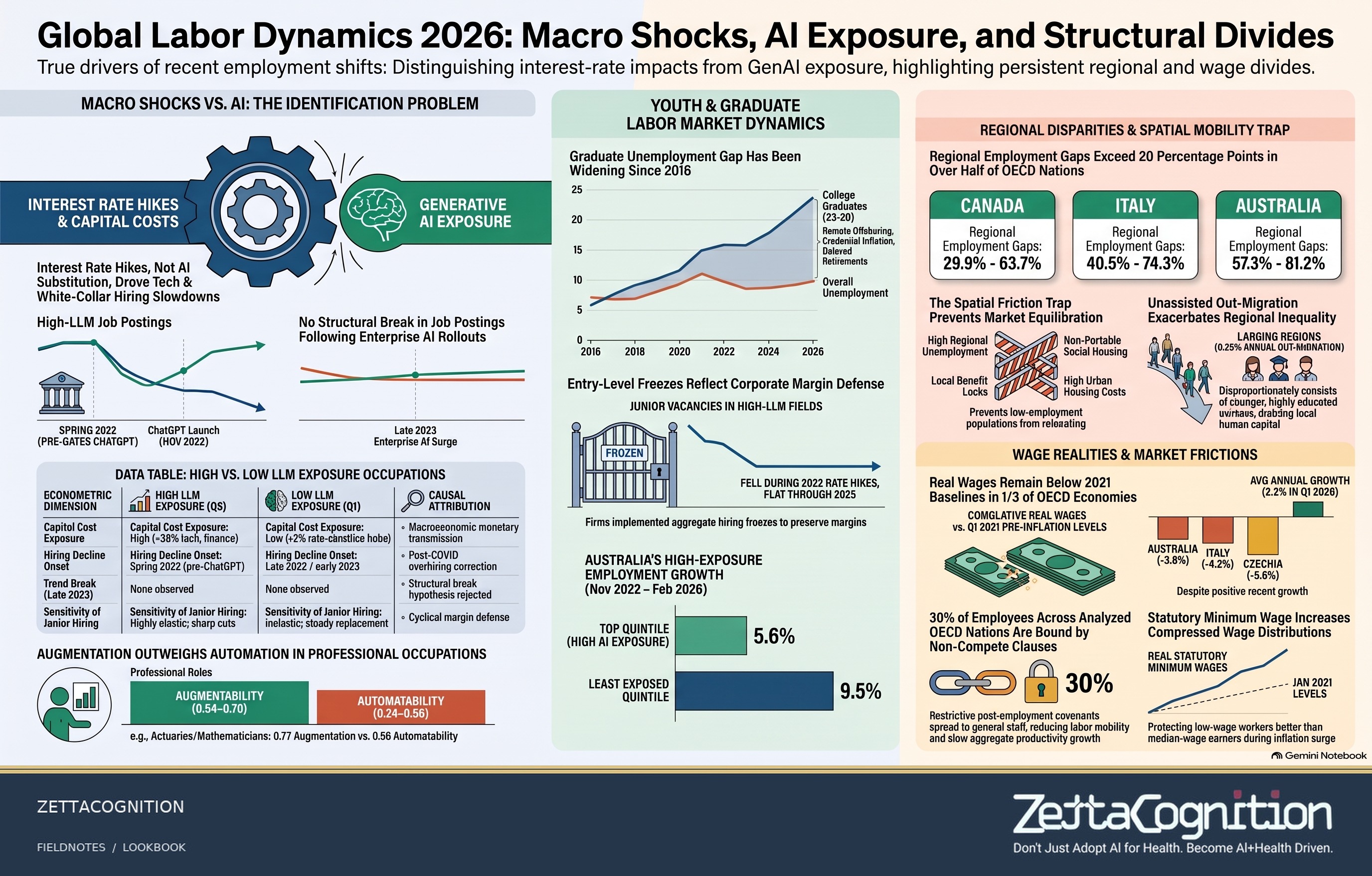
The Global Labor Dynamics plate sets macro shocks beside AI exposure, then follows the consequences to graduates, regions and wages. Read it as a map of competing explanations; its detailed numbers are source annotations, not verified benchmarks.
The identification problem
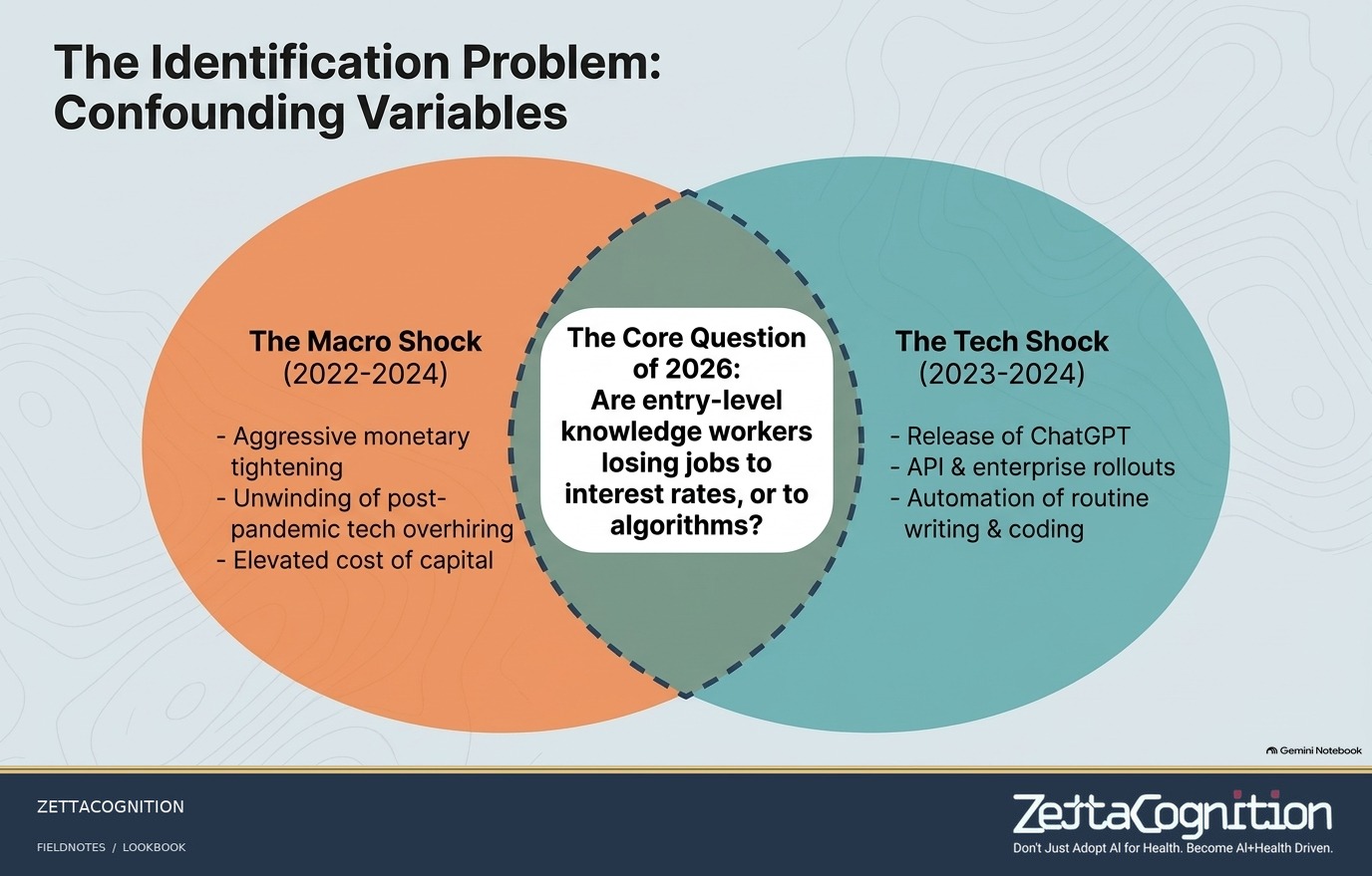
Imagine a hypothetical consulting firm in 2023. It stops recruiting graduate analysts. Its leaders also start piloting a generative AI tool. A journalist connects the two facts, and a story about algorithmic replacement is born. But the firm’s borrowing costs have risen sharply, its clients have cut discretionary projects and it hired heavily during the pandemic. Which of these caused the freeze? From the outside, the two explanations look identical.
This is what economists call an identification problem, and the source research places it at the centre of the 2026 debate. Occupations most exposed to large language models are concentrated in information and communications, finance and professional services. Those are also the sectors most sensitive to interest rates. The source cites research indicating that roughly 38% of workers in the most LLM-exposed group work in these three industries, compared with under 2% in the least exposed group—a figure presented here as the source’s reading of cited studies, not an independently verified statistic.
If exposure to AI and exposure to the cost of capital point at the same jobs, a naive correlation between the two will always look like evidence of replacement. Separating them requires timing, comparison groups and patience. It requires asking what would have happened to those roles if no language model had been released.
Before acting on a jobs headline, run the diagnosis. These five steps are an editorial aid for leaders, not an OECD method or an economic forecast.
Diagnose before you blame the algorithm
- 1Time
Check whether the hiring decline began before AI adoption.
- 2Compare
Set exposed roles against rate-sensitive sectors and the cycle.
- 3Locate
Ask where the gap is: region, wage or entry point.
- 4Prepare
Teach graduates to evaluate and oversee AI-assisted work.
- 5Place
Invest in regions, not only in relocation.
The timeline does not fit
The source research’s most persuasive argument is chronological. According to its synthesis, the downturn in technology and white-collar hiring began in the spring of 2022, as central banks began raising rates—about six months before ChatGPT was released to the public in November 2022. Enterprise-scale demand for AI skills, it notes, rose later, from mid-2023 into 2024.
A cause should not arrive after its effect. If generative AI were substituting for entry-level workers at scale, the research argues, job postings in highly exposed occupations should have bent sharply downward relative to less exposed ones once enterprise adoption accelerated. The source reports no such structural break across the economies it reviews; relative postings tracked the broader business cycle instead.
That is not proof that AI has no labour-market effect. Adoption is still unfolding, and effects may emerge unevenly by task, firm and country. It is an argument about evidence quality: a single headline correlation is not enough to blame a technology for a hiring freeze that its timing does not explain. Policy built on a misdiagnosis can regulate the wrong thing while the real constraint goes untouched.
The graduate gap began before the chatbot
Young graduates are the group most often named as AI’s first casualties, and their position has indeed weakened. The source research draws on the Outlook’s analysis showing the unemployment gap between recent graduates and the wider working-age population widening in several economies since around 2016—years before transformer-based tools reached the workplace.
It points to slower, structural pressures instead: entry-level knowledge work sourced across borders, employers placing less weight on degrees and more on demonstrated capability, and longer careers that slow turnover in middle management and narrow the pipeline beneath it. These are the author’s interpretations of drivers, presented as hypotheses for leaders to test rather than settled causal findings.
Here the AI question returns in a more useful form. The source suggests that, in many professional roles, generative tools are absorbed into workflows rather than replacing whole jobs, raising expectations of what a junior can produce. That is augmentation—but it still changes the entry point. If a first job now assumes the ability to evaluate, verify and direct AI-assisted work, education has to prepare people for that judgement, not only for the routine tasks that once served as training.
Where you live still decides a lot
The Outlook’s 2026 theme is geography, and here the evidence is sobering. The source research reports that in more than half of OECD economies, employment rates between small regions differ by more than 20 percentage points. Its country examples—from Canada and Italy to Australia—show places within one nation that seem to belong to different labour markets. Those regional figures are reproduced from the source artwork and are not independently verified here; some differ between the infographic and the slides, and the original definitions should be checked before reuse.
Telling people to move to opportunity is not an adequate answer. The source notes that those who leave lagging regions tend to be younger, more qualified and already employed. People who are unemployed or inactive move less, held back by housing costs, benefits that do not travel and the loss of family support. Relocation can therefore deepen the divide it was meant to close, draining a region of the people best placed to renew it.
Consider a hypothetical town where a major employer has closed. The most mobile residents leave for the city. Those who stay face fewer services, fewer local jobs and fewer people to start new ones. No AI policy will reach them. A housing policy, a regional education hub or a digital connection might.
Aim the anxiety at the right target
The slide deck ends with a provocative chart: public anxiety concentrated on AI job replacement, while spatial divides, youth entry barriers, real-wage stagnation and restrictive post-employment clauses carry, in the author’s assessment, a larger structural threat. The source cites a figure of around 30% of employees bound by non-compete clauses across 15 OECD countries; it is presented here as a source claim to verify, not a confirmed statistic.
From that diagnosis come four editorial proposals. Do not attribute interest-rate driven hiring freezes to AI, or expect AI restrictions to revive them. Build augmentation into vocational and higher education so that graduates learn to evaluate and oversee AI-assisted work. Use place-based investment in regional infrastructure, education and services rather than relying on relocation alone. And reduce barriers for disadvantaged workers who do choose to move, including through more portable housing support. These are proposals for discussion, not evaluated interventions or official OECD recommendations.
The point is not to dismiss concern about AI. It is to take work seriously enough to diagnose it properly. When a graduate cannot find a first job, they deserve an explanation grounded in evidence, and a response aimed at the actual cause. An algorithm makes a convenient villain. The harder, more useful work is to fix the cost of entry, the wage that has not recovered and the map that still decides too much.
The identification-problem slide shows why the debate is so hard: the macro shock and the tech shock overlap on the same jobs. The question in the middle is the one every policy should answer first.
Diagnose the labour market before you blame the algorithm.