The teacher shortage is a design problem
Schools can fill a timetable and still lose expertise. The teacher shortage is a test of how education systems value, prepare and support the people AI cannot replace.
A timetable can look complete while a school is quietly running short of expertise. A mathematics class has a teacher, but not one trained in mathematics. A vacancy is filled, but by the third relief arrangement of the term. Professor Amandeep Sidhu’s research on the OECD’s education indicators and the global teacher shortage starts from an uncomfortable idea: the shortage is not only a recruitment problem. It is a design problem—about how systems count, value, prepare and support the people on whom every promise of educational technology finally depends.
A full timetable can hide an empty seat
Imagine a secondary school in a regional town at the start of the year. Every class on the timetable has a name beside it. On paper, there is no vacancy. In practice, a physics class is taught by a capable colleague trained in another subject, a new graduate is carrying a heavy load without an experienced mentor nearby, and the school leader is already planning for a retirement next year. This scene is hypothetical. Its point is that a shortage can be real before it appears as an unfilled post.
The OECD distinguishes between several faces of the problem: posts left unfilled, teachers who are not fully qualified for their role, teachers still in the process of qualifying and teachers who leave the profession. Those categories matter because each implies a different response. A vacancy calls for recruitment. A qualification gap calls for preparation and support. Attrition calls for a hard look at working conditions, recognition and career design.
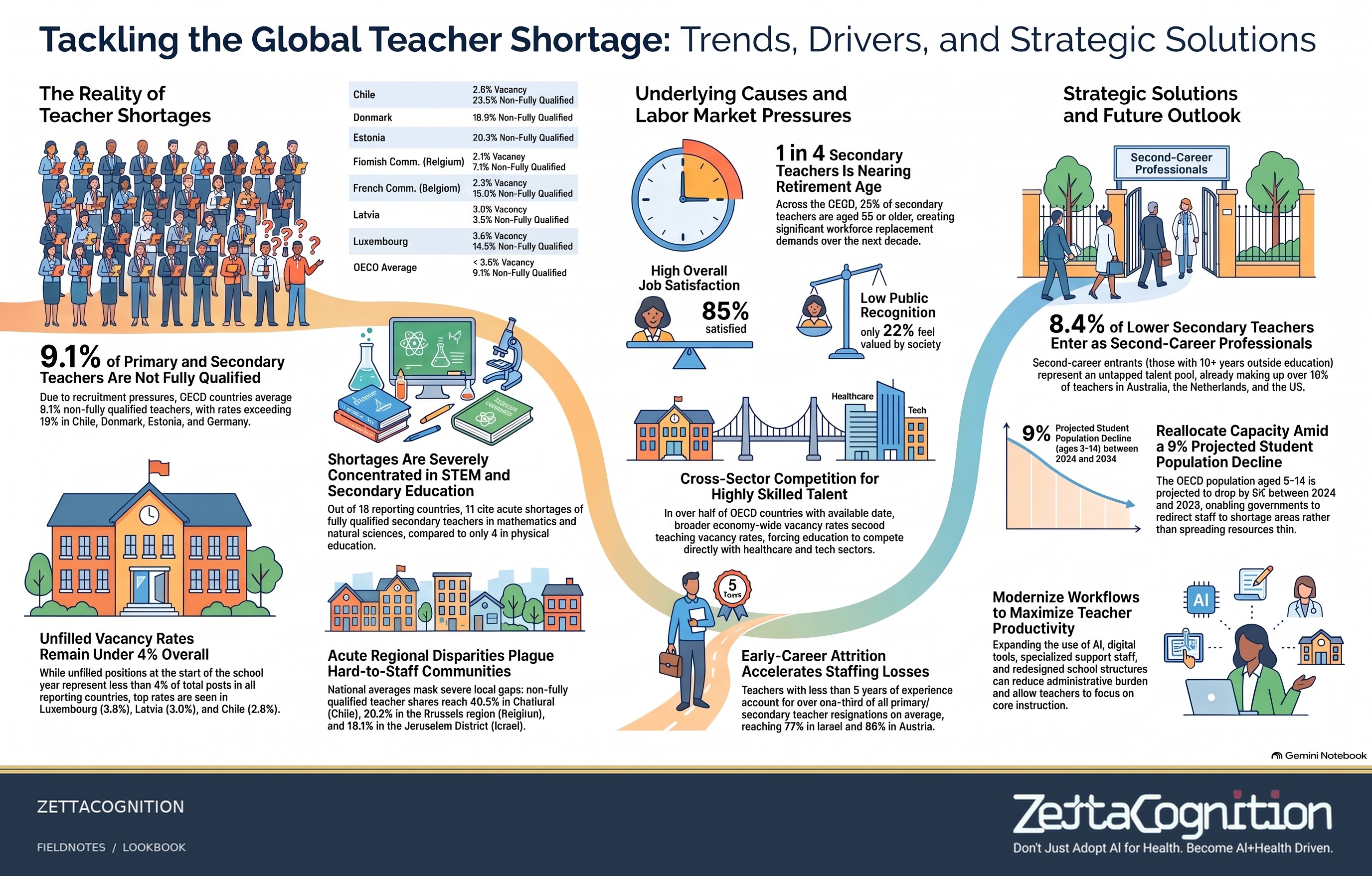
Education at a Glance 2025 reports that, on average across countries with data for 2022/23, the share of teachers who are not fully qualified is slightly higher in secondary education (7.1%) than in primary education (5.6%). The original infographic in this research uses a broader 9.1% figure for primary and secondary teachers combined. That difference is a reminder to check the level, year and definition behind every headline number before comparing one system with another.
The Global Teacher Shortage plate traces a path from the reality of shortages to their causes and possible responses. Its country rates and percentages are retained as unverified source annotations; follow the logic of the journey rather than treating each figure as a current benchmark.
Measure before you compare
The source document is, at heart, an analysis of the OECD’s technical notes: the accounting rules and classifications that turn national data into comparable indicators. That sounds dry. It is where many policy arguments are quietly won or lost. A student-teacher ratio is a measure of how resources are allocated across a system; it is not the same thing as class size, which describes the group a teacher actually stands in front of.
The research also highlights a particular Australian challenge. Australia maps its qualifications, organised through the Australian Qualifications Framework and its national classification of education, to the international ISCED 2011 standard. The fit is imperfect, especially around vocational and upper-secondary attainment, so cross-national comparisons need care. The source also notes that teacher salaries and related workforce measures are assembled from state and territory systems rather than a single national collection.
None of this makes international comparison useless. It makes it disciplined. A leader who knows how a measure is built can use it to ask a better question. A leader who treats every ranking as a verdict risks importing a solution to the wrong problem. The first step in addressing a teacher shortage is to agree what kind of shortage is being described.
Turn the diagnosis into design. These five moves are an editorial planning aid for school systems, not an OECD checklist or an evaluated programme.
Design the system around the teacher
- 1Count
Separate vacancies, out-of-field teaching and attrition.
- 2Target
Find the subjects and communities with the sharpest gaps.
- 3Widen
Open second-career routes without lowering preparation.
- 4Retain
Mentor early-career teachers and make expertise a career.
- 5Augment
Use AI to protect teaching time, not replace judgement.
Satisfied, but not valued
One of the most striking contrasts in the research slides is between how teachers feel about their work and how they believe society regards it. The source reports high overall job satisfaction alongside a much smaller share of teachers who feel their profession is valued by society, and lower satisfaction with pay. These percentages belong to the original artwork and are not independently verified here. The tension they describe is nonetheless worth taking seriously.
A profession can be meaningful and still be hard to stay in. If the early years are the most demanding, if progression feels distant and if public conversation treats teachers as easily substituted, satisfaction in the classroom may not be enough to hold people. The research points to early-career attrition and an ageing secondary workforce as two pressures that compound each other: experience leaves at one end while newcomers struggle to stay at the other.
Career structure is part of the answer. In Australia, teachers can seek certification as Highly Accomplished or Lead Teachers against the national professional standards, a pathway administered with AITSL and certifying authorities. The source argues that the small number of certified teachers suggests the route to higher recognition is narrow. That is an interpretation worth testing, not a settled finding—but it asks the right question: does the system reward expert teaching without requiring excellent teachers to leave the classroom?
Widen the doorway without lowering the standard
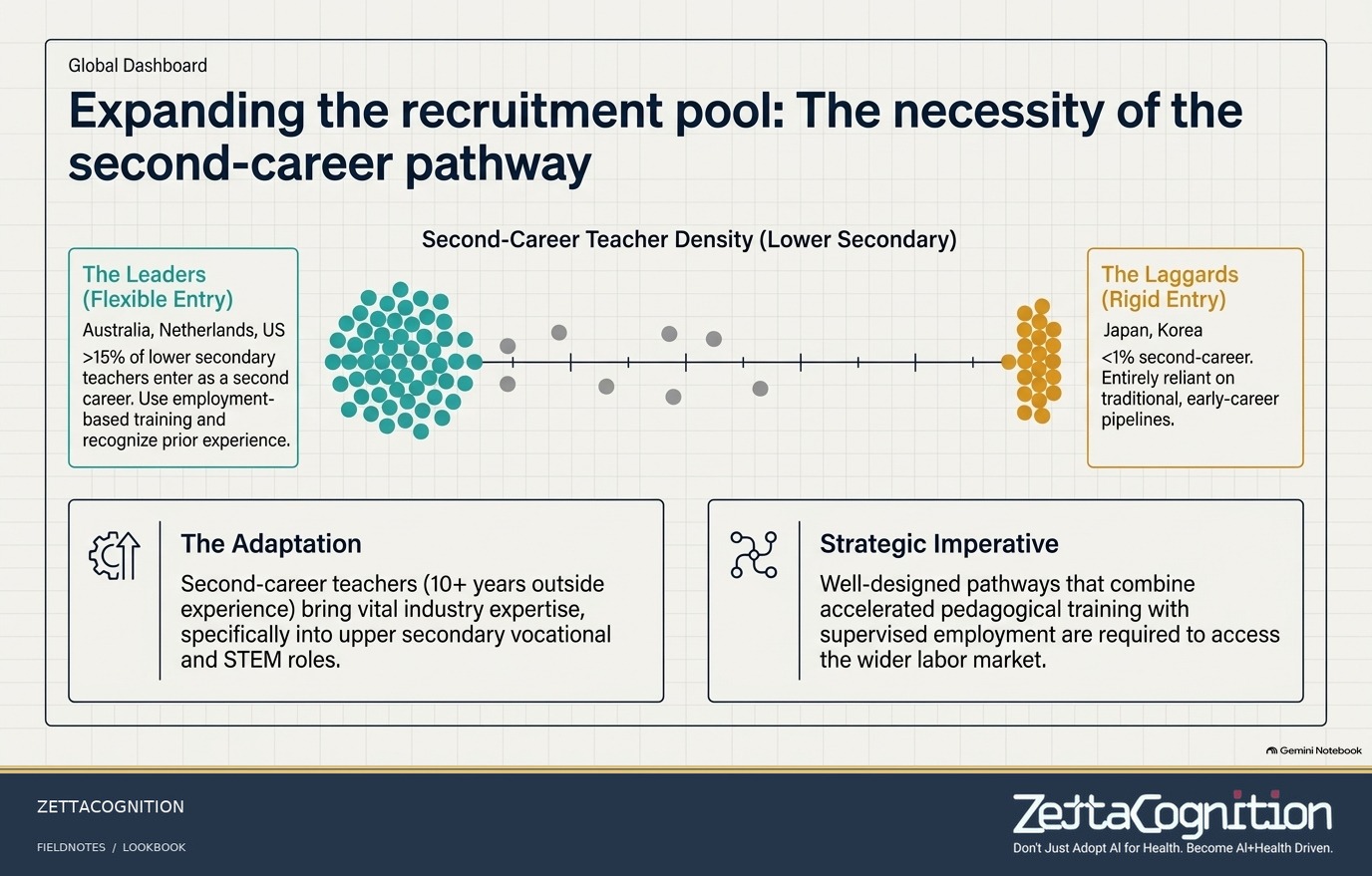
The research makes a case for second-career teachers: people who bring years of experience from engineering, health, science or industry and choose to teach. Some systems already rely on them more than others. The Australian Government’s High Achieving Teachers Program supports employment-based pathways, through which participants work in schools while completing an accredited teaching qualification.
This is not a shortcut around preparation. A professional engineer does not automatically know how to explain an abstract idea to a fourteen-year-old, sequence a unit or manage a classroom where students arrive with very different starting points. A well-designed pathway combines respect for prior experience with serious training, supervised practice and mentoring. The goal is a teacher who is fully prepared, sooner—not a vacancy filled with an unsupported newcomer.
Demography may offer room to plan. The source points to projected declines in the school-age population in many OECD systems. That will not resolve shortages automatically; a falling national total can coexist with acute gaps in particular subjects and places. But it gives governments a window to redirect capacity toward the hardest-to-staff schools and subjects, rather than spreading effort thinly.
AI can lighten the load; it cannot carry the class
It is tempting to see artificial intelligence as the answer to a teacher shortage. The research argues the opposite case with some force: technology amplifies the quality of teaching it meets. In the slides, tools deployed inside a teacher-led, Socratic design are presented as supporting critical inquiry, while unguided answer engines are presented as risking passive consumption. The specific score effects printed in the artwork are source claims, not verified findings.
The practical opportunity is more modest and more useful. AI and other digital tools might reduce administrative burden, help prepare differentiated materials or support feedback, giving teachers more time for the human work of explanation, judgement and relationship. That value depends on the tool being chosen by educators, aligned with the curriculum and used in ways students are taught to question. A dashboard cannot notice that a quiet student has stopped trying. A teacher can.
The research therefore links AI integration with teacher capability: knowledge of how people learn, explicit instruction where foundations are still forming and the ability to judge when a tool helps and when it bypasses productive effort. Investing in technology without investing in the people who use it is like buying instruments for an orchestra and cancelling the rehearsals.
Design the system around the teacher
A credible response begins with better questions. Which subjects and communities face the most acute gaps? How many teachers are working outside their field, and with what support? Where do early-career teachers leave, and why? Which tasks could be removed from a teacher’s week without weakening learning? These questions can be answered locally even when international data are imperfect.
From there, the proposals in this research form a coherent agenda: count the different kinds of shortage honestly, widen entry routes while protecting standards, make expert classroom teaching a visible career, and deploy technology to protect teachers’ time rather than to replace their judgement. These are editorial proposals, not evaluated interventions or official policy advice. Their strength is that they treat the teacher as the centre of the system rather than its most flexible variable.
The future of education will be shaped by many technologies. It will still be decided in classrooms, by people who know their subject, know their students and have the time and standing to teach well. A system that wants the benefits of AI must first decide that those people are worth designing for.
The second-career slide shows why the doorway into teaching matters. Read it with one test in mind: does a new pathway bring expertise in while still preparing and supporting every new teacher properly?
AI can lighten a teacher’s load. Only a well-designed system can keep the teacher.