Governance has to move at machine speed
When algorithms act in milliseconds, an annual checklist cannot be the last line of defence.

In automated markets, a decision can be made, executed and amplified before a human has time to open a dashboard. That changes what responsible oversight must look like.
The moment between signal and action
Picture a model reacting to a sudden change in market conditions. It identifies a pattern, submits an order and finds that other automated systems are responding too. By the time a human analyst notices the anomaly, the original decision may have been repeated at a scale no one intended.
This is not an argument against automation. It is an argument for deciding, before deployment, what the system may do without another person’s approval. Position limits, data-quality checks and the ability to halt trading must live where decisions are made, not in a policy folder elsewhere.
A control should be tested against failure as well as ordinary operation. What happens if an input feed is stale, if two models reinforce each other, or if an emergency stop depends on the same service that has failed? The uncomfortable scenarios are precisely the ones assurance exists to surface.
Human oversight becomes more meaningful when it has a defined point of intervention. Asking a person to watch a dashboard that updates after the trade is not the same as giving them the authority and information to change what happens next.
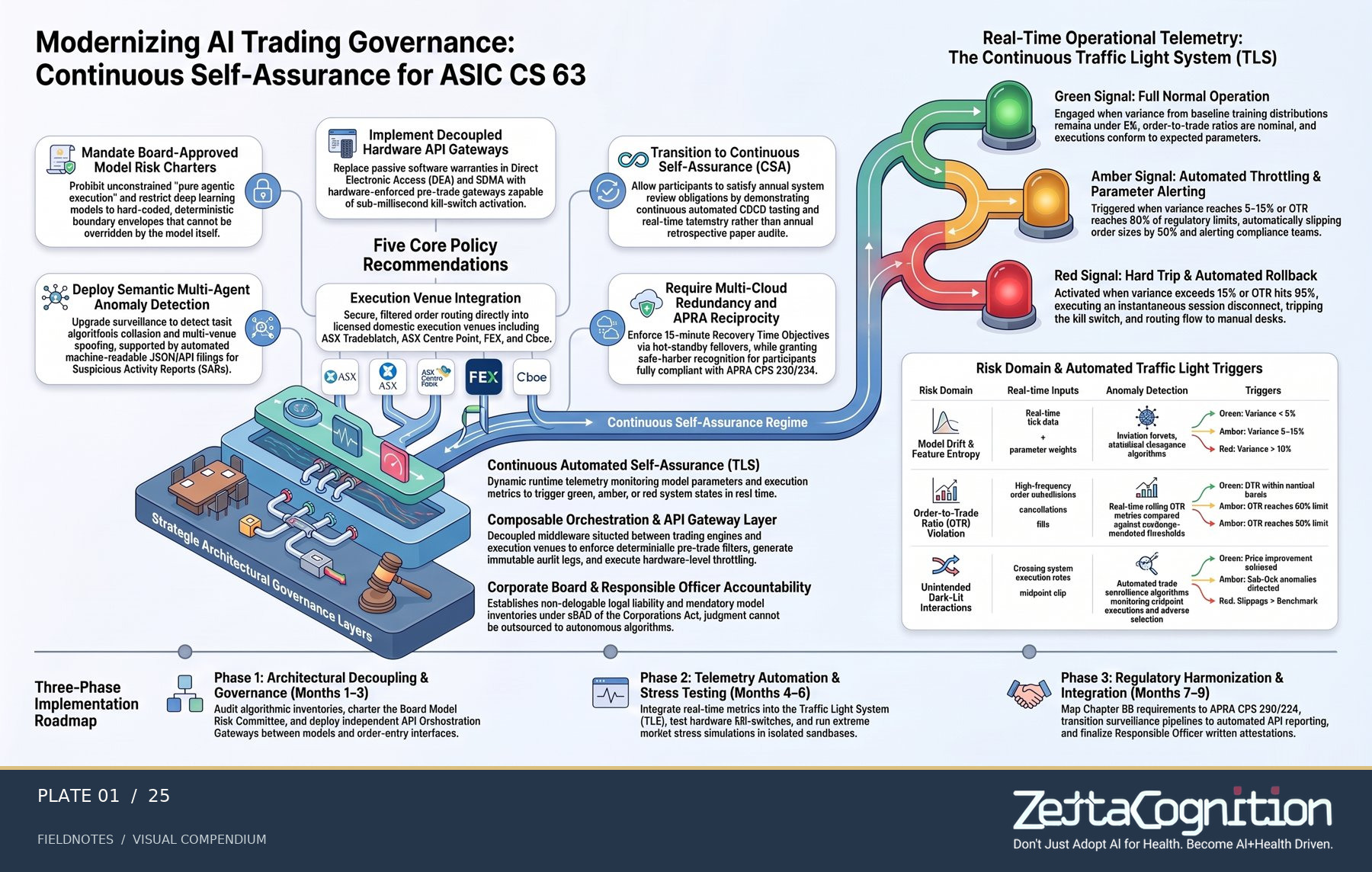
The governance plate follows the interval that matters most: the fraction of time between a signal and an action. Find the checkpoint before execution, not merely the report after it.
Evidence after the event
When something goes wrong, an institution needs more than an assertion that its system was approved. It needs to reconstruct the model version, its inputs, the limits in force and the sequence of actions. That record helps distinguish a surprising but authorised response from a control failure.
Responsibilities should be legible across teams. The person who validates a model, the person who owns a trading strategy and the person authorised to stop it have different jobs. Ambiguity between them is itself a risk, especially when a system is operating faster than conversation can occur.
Continuous assurance is therefore not endless bureaucracy. It is a way of keeping the organisation’s promise attached to the system while the system is running. The faster the technology acts, the less defensible it is to discover its boundaries only in the annual review.
The sequence below is deliberately short. If the stop authority exists only after the action, oversight has missed the moment it was built for.
Where oversight must sit
- 1Signal
The model spots a pattern in live data.
- 2Checkpoint
Pre-set limits test the decision before it runs.
- 3Action
The order executes in milliseconds.
- 4Stop
A named person has authority to halt it.
- 5Review
Lessons feed back into the limits.
From policies to controls
A written commitment to responsible AI matters, but it does not interrupt an unsafe trade. Fast-moving systems need safeguards embedded in the path of action: pre-trade checks, limits, throttles and a reliable way to stop activity when behaviour leaves its expected bounds.
This is the difference between describing a risk and containing it. Governance must be part of the architecture, not a document consulted after the fact.
Accountability cannot be automated away
Clear ownership of every model, traceable decisions and durable audit records make it possible to understand what happened and who was responsible. Automation can assist with monitoring, but it cannot become a substitute for human accountability.
The more autonomous a system becomes, the more explicit its escalation paths and failure boundaries need to be.
Continuous assurance
Periodic reviews capture a snapshot. Continuous assurance asks whether a system remains within its authorised operating conditions right now. It joins monitoring, intervention and evidence into a single operational discipline.
In markets where seconds matter, that shift is not merely a compliance improvement. It is an essential part of maintaining trust.
The trading architecture shows why responsibility cannot sit in one dashboard. Limits, records and escalation have to remain connected even when no one is watching each individual decision.
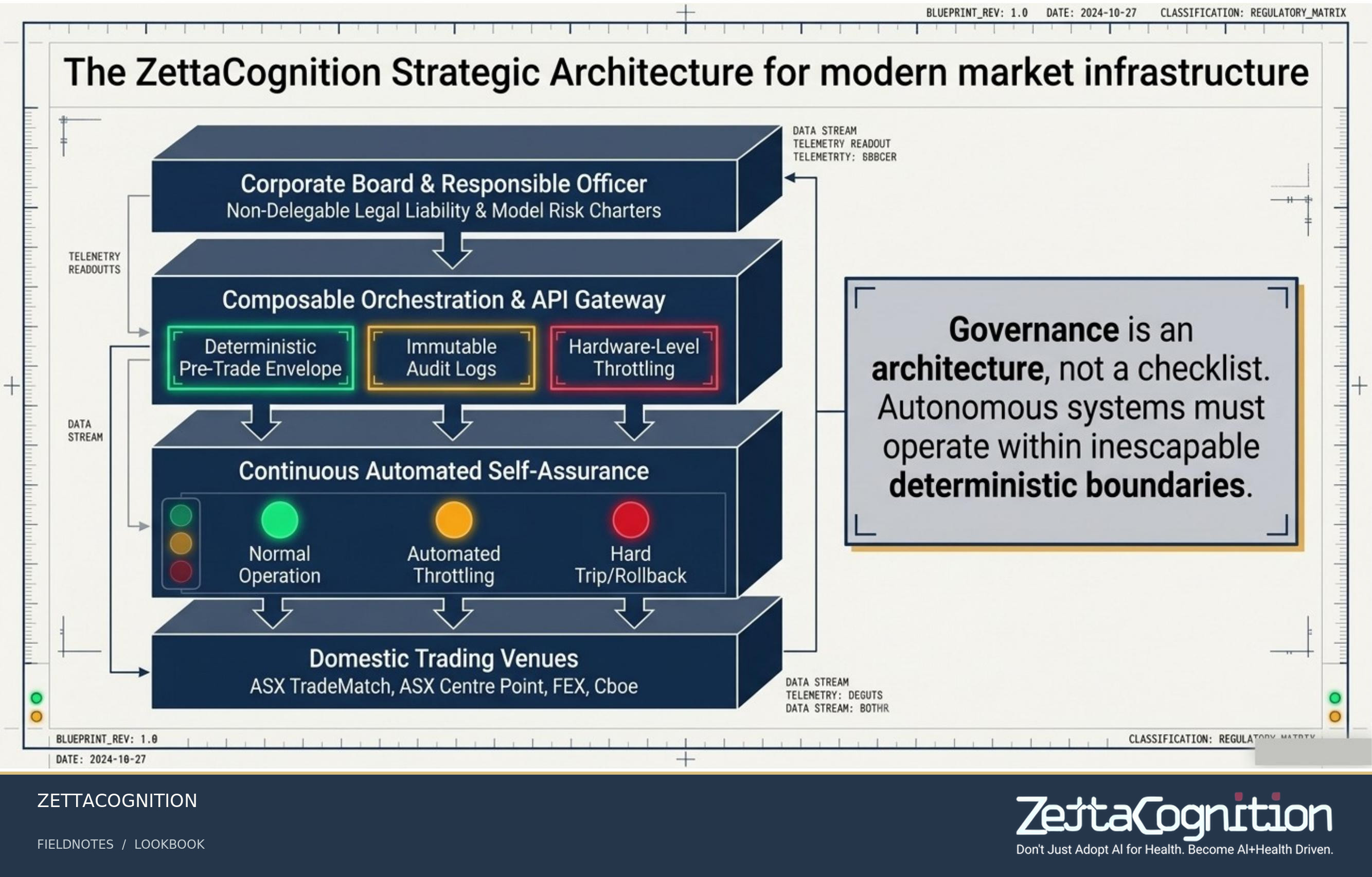
A system that can act faster than a person can react needs its boundaries designed before the first order, not written up after the last one.
Cite this story
Sidhu, A. S. (2026). Governance has to move at machine speed. Fieldnotes: AI Research Journal, 1(3). https://doi.org/10.5281/zenodo.23331046