International students need more than a visa
International education is being recalibrated. The real test is not how many students cross a border, but whether the system makes their journey worth taking.
A visa opens a border. It does not open a life. Behind every international enrolment is a person trying to turn an offer, a financial commitment and an unfamiliar city into a future. Professor Amandeep Sidhu’s research on international student mobility asks what happens when that human journey meets a university funding model, a housing constraint and a government changing direction. The answer cannot be found in an arrivals count alone.
The offer is only the beginning
Imagine a student who has accepted a postgraduate place overseas. The course looks right. The family has calculated tuition, exchanged savings into another currency and planned around a promised start date. Then visa processing changes, a housing search becomes more expensive and the rules for bringing a partner are no longer what they expected. Nobody in this hypothetical scene has necessarily broken a rule. Yet the student is carrying the consequences of decisions made in several different systems.
The source research examines international education through six destinations: Australia, Canada, France, Germany, the Netherlands and the United Kingdom. Its organising idea is that mobility is no longer simply a recruitment question. Education policy meets migration policy, foreign relations, institutional finance and the practical capacity of a city to welcome people. A university can issue an offer more quickly than a community can create a room to live in.
That changes the leadership task. An admissions target can be achieved while the student experience deteriorates. Equally, a reduction in arrivals can ease one pressure while exposing a funding weakness elsewhere. The question is not whether international education is good or bad. It is what would make it durable, credible and worth choosing—for students as well as institutions.
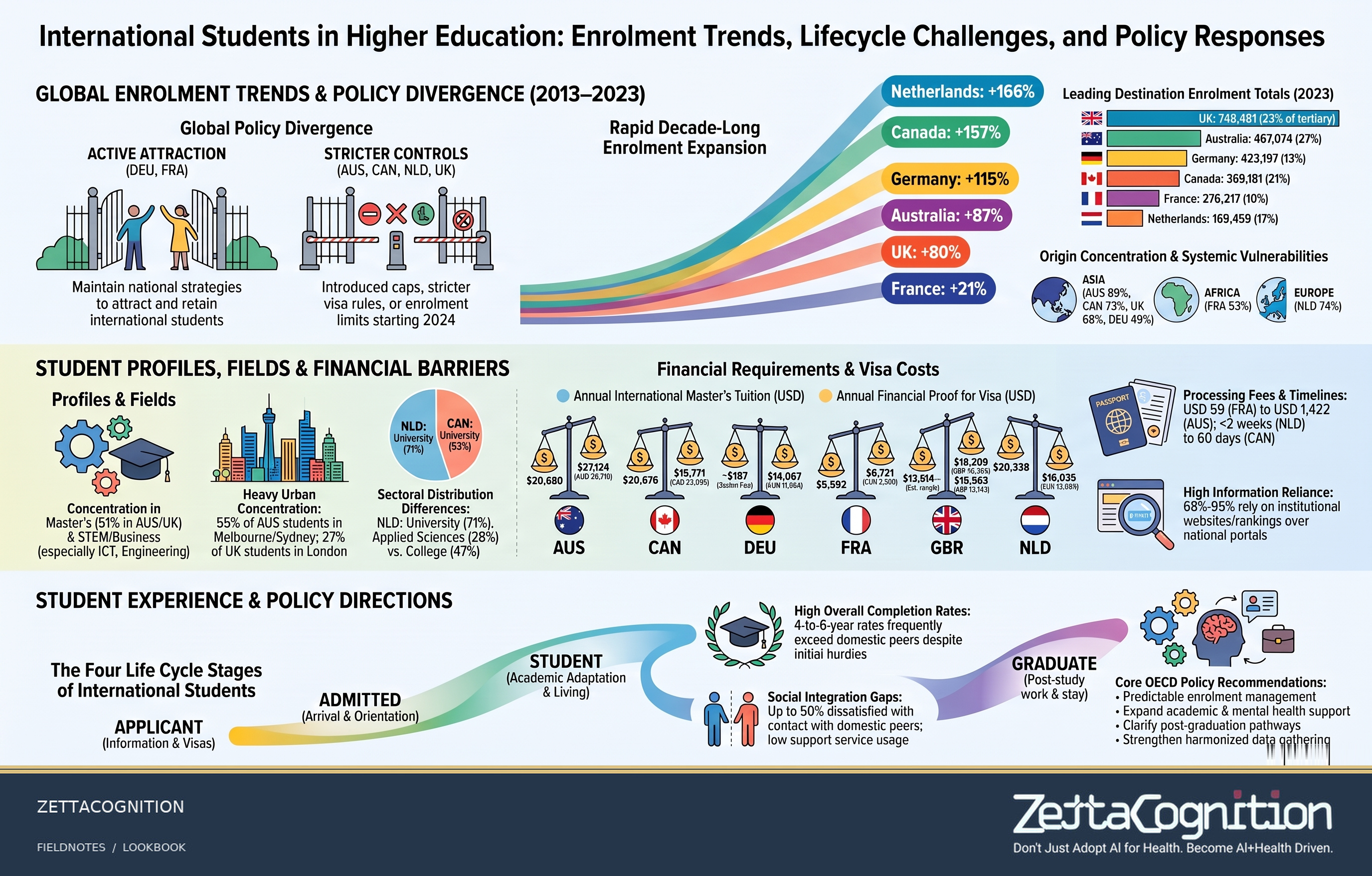
The International Higher Education Student Trends plate places policy, finance and the student lifecycle in one frame. Its detailed numbers are retained as unverified source annotations. Follow the relationships between the panels, rather than treating every figure as a current official benchmark.
A falling visa line is not an empty lecture theatre
There is evidence of a policy turn, but the measures need careful handling. The UK Home Office reports 393,125 sponsored study visas granted to main applicants in 2024, 14% fewer than in 2023 and 46% more than in 2019. That is a defined administrative measure over a defined period. It is not the number of international students enrolled at universities, nor does it identify every reason an individual chose a destination.
A visa grant, a commencement and an enrolment describe different stages. A grant may precede travel. A commencement records a new start. Total enrolments include people continuing multi-year courses, and some collections count course enrolments rather than unique students. A system can therefore show a sharp fall in new permissions while its total student population remains comparatively high. Comparing those lines as though they were interchangeable can turn a useful warning into a misleading headline.
The original infographic and slides print detailed growth rates, country totals, tuition figures and financial-proof requirements. Those annotations remain part of the source artwork; this journal has not independently verified all of them. Currency conversions, reference years, qualification levels and definitions can change the comparison. The article uses the verified UK visa figure as an example, not as a substitute for a complete cross-country audit.
Policy also needs a date and a scope. The source contrasts tighter controls in several destinations with continued attraction strategies in France and Germany. That is a comparative interpretation, not a claim that every institution follows one national script or that every proposed measure is enacted law. Applicants should check the relevant official rules at the time they apply. A research diagram is not visa advice.
Bring the comparison back to the journey. These five questions are an editorial planning aid for institutions, not an immigration checklist or a promise of outcomes.
Make the whole journey work
- 1Inform
Explain costs, conditions and uncertainty before commitment.
- 2Prepare
Connect arrival plans with real accommodation and support.
- 3Include
Look beyond marks to participation and belonging.
- 4Connect
Make help reliable across institutional handoffs.
- 5Review
Check the graduate pathway without promising a visa outcome.
When the student becomes the balancing item
The presentation’s revenue-versus-subsidy seesaw captures a difficult institutional tension. When international fee income supports wider university activity, a recruitment shock can travel beyond the admissions office. Research plans, staffing and course provision may depend on assumptions about future arrivals. But a student is not a funding instrument who can be summoned whenever the institution needs to close a gap.
The source argues that different public-funding and fee arrangements create different kinds of exposure. Its country-level tuition comparisons should be read with caution: fees differ by institution, course, residency status and exemption, and a national average is not a quotation for a particular degree. The more useful governance question is whether leaders know which commitments become vulnerable when an expected intake does not arrive.
A prudent response would test scenarios rather than merely pursue a new market. What happens if visa decisions slow? If one origin country supplies a large share of applicants? If students cannot find affordable accommodation? Diversification may reduce concentration, but it should not mean moving recruitment to people whose information or support is weaker. The institution should be able to explain how its financial resilience and its obligations to students fit together.
Transparency matters before payment. Students need understandable information about the full cost, the conditions attached to an offer, refunds, course delivery and available support. A fee schedule that is technically complete but practically incomprehensible transfers uncertainty to the person least able to absorb it. Credibility begins when the promise can be understood, not only when the contract can be defended.
Four stages, one unfinished promise
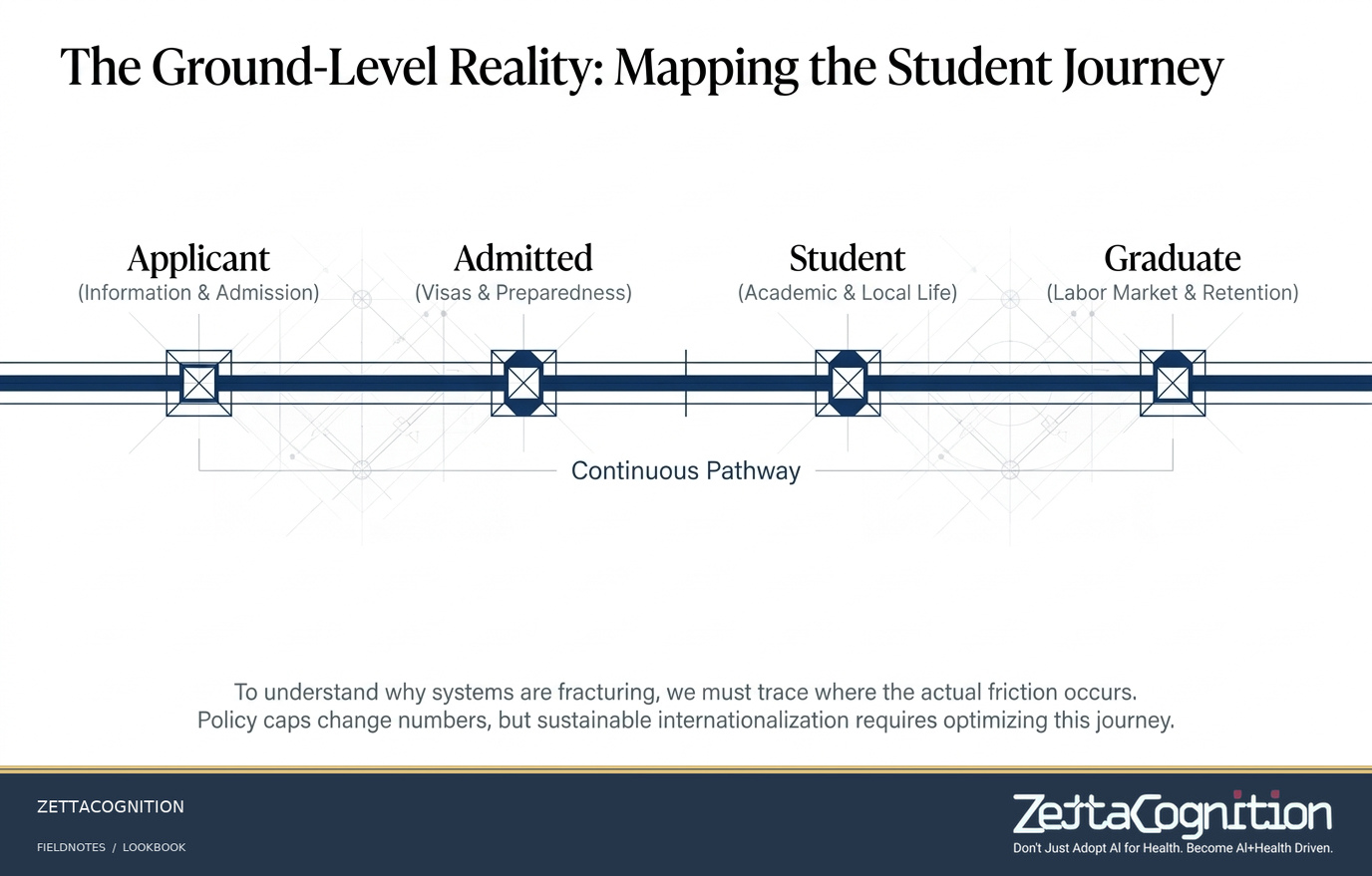
The slide deck offers a useful journey map: applicant, admitted student, student and graduate. Each stage has a different point of friction. Applicants must judge information and navigate requirements. Admitted students need a workable arrival plan. Enrolled students need academic access, social connection and support. Graduates need clarity about the next step, without being promised an immigration outcome a university cannot control.
Consider the hypothetical student after arrival. They attend classes, submit work and appear to be progressing. Outside class, their accommodation is distant, paid work consumes the time they hoped to spend studying and their social world rarely extends beyond others facing the same uncertainty. An institution that checks only marks may conclude that everything is working. An institution that listens across the journey may discover a success that feels precarious.
The source’s completion and social-isolation percentages are not independently verified here, so they should not be used as population estimates. The underlying distinction remains important: academic progression and belonging are not the same thing. A student can pass and still feel peripheral. Orientation is an event; inclusion is a continuing pattern of relationships, access and participation.
Support should therefore be designed where the handoffs happen. Can a student find accurate help without being passed between admissions, accommodation, academic services and an external adviser? Is there a route to report misleading information or seek wellbeing support safely? Institutions should not infer individual need from nationality or treat every international student as the same kind of learner. Ask what the person needs and make the answer actionable.
Manage capacity without making people the problem
Housing and public infrastructure belong in international education planning. They should not become a story in which students alone are blamed for pressures with multiple causes. A serious capacity discussion asks what is available, where growth is occurring, who bears the cost and which agencies can act. It distinguishes a local constraint from a slogan about a whole population.
Predictability is part of fairness. Governments need room to change policy, but institutions and students also need clear timing, transitional arrangements and honest communication. An offer issued under one set of assumptions should not be marketed as though a future permission is guaranteed. Providers should communicate uncertainty while there is still time for a person to make an informed choice.
The research proposes a shift from volume-led competition toward quality and capacity. In practice, that could mean connecting recruitment decisions with accommodation planning, teaching resources, complaints, student feedback and graduate pathways. These are editorial proposals, not evaluated interventions or a universal regulatory checklist. Their value is that they make the institution look beyond the next intake.
Better evidence would follow the whole journey. Track the gap between an offer and arrival, interruptions in study, access to support and the experience after graduation. Collect only what is necessary, explain its use and avoid turning student monitoring into surveillance. A dashboard matters when it triggers a responsible decision; it is not evidence of care simply because it exists.
Compete on a promise you can keep
The strongest international education offer is not the loudest promise of opportunity. It is a promise that survives contact with reality. The course is delivered as described. The costs are intelligible. Help is available when needed. The student can participate in the academic community rather than merely finance it. The path after graduation is explained honestly, including the limits of what the institution can guarantee.
For leaders, the starting point could be one cohort and one difficult handoff. Follow what happens between admission and arrival, or between academic success and social connection. Bring the responsible teams together, hear students directly and change the process that repeatedly produces confusion. Check the result before expanding the response. This is a proposed way to learn from the system, not a claim that the source has already demonstrated an improvement.
International mobility can connect knowledge, institutions and lives across borders. Preserving that possibility requires more than defending an export total or announcing a cap. It requires a system that can reconcile educational purpose, public capacity and a person’s reasonable expectation of being treated fairly. The destination should be an education worth completing—not simply a border worth crossing.
The student-journey slide separates applicant, admitted student, student and graduate. Use it to locate responsibility at each handoff: who gives the next reliable answer, and who notices when the promise stops matching the experience?
A visa opens a border. A credible education opens a future.