When AI answers, who is learning?
PISA 2025 raises a deeper question for STEM education: can students explain, test and challenge an answer when the machine is no longer beside them?
An answer can arrive in seconds. Understanding takes longer. That difference is becoming the defining question of AI in education: not whether a student can produce a convincing response, but whether they can explain why it deserves to be believed. Professor Amandeep Sidhu’s PISA 2025 STEM research turns the debate away from the tool on the desk and toward the thinking that must remain with the learner.
The perfect answer and the missing explanation
Imagine a science lesson about a river whose oxygen levels are falling. A student asks an AI assistant for an explanation and receives a fluent paragraph about nutrients, algae and decomposition. The terminology is right. The prose is tidy. Then the teacher asks which measurements would distinguish that explanation from a change in water temperature. The paragraph cannot answer for the student. This classroom scene is hypothetical, but the distinction it illustrates is real: producing an explanation and being able to investigate it are different accomplishments.
The source research calls for a shift from AI as an answering engine to AI as an object of critical inquiry. That is a powerful educational proposition. A generated explanation becomes something students can inspect: what assumptions does it make, which evidence would support it, and what observation might show it is wrong? Instead of hiding the intellectual work, the tool can make that work more visible.
This is not an argument that every lesson should include a chatbot. It is an argument that, when a tool is used, the learning objective should determine its role. A student who needs to practise explanation should not have that practice quietly removed by a feature designed to complete the task. The finished page is evidence of an output. It is not, by itself, evidence of learning.
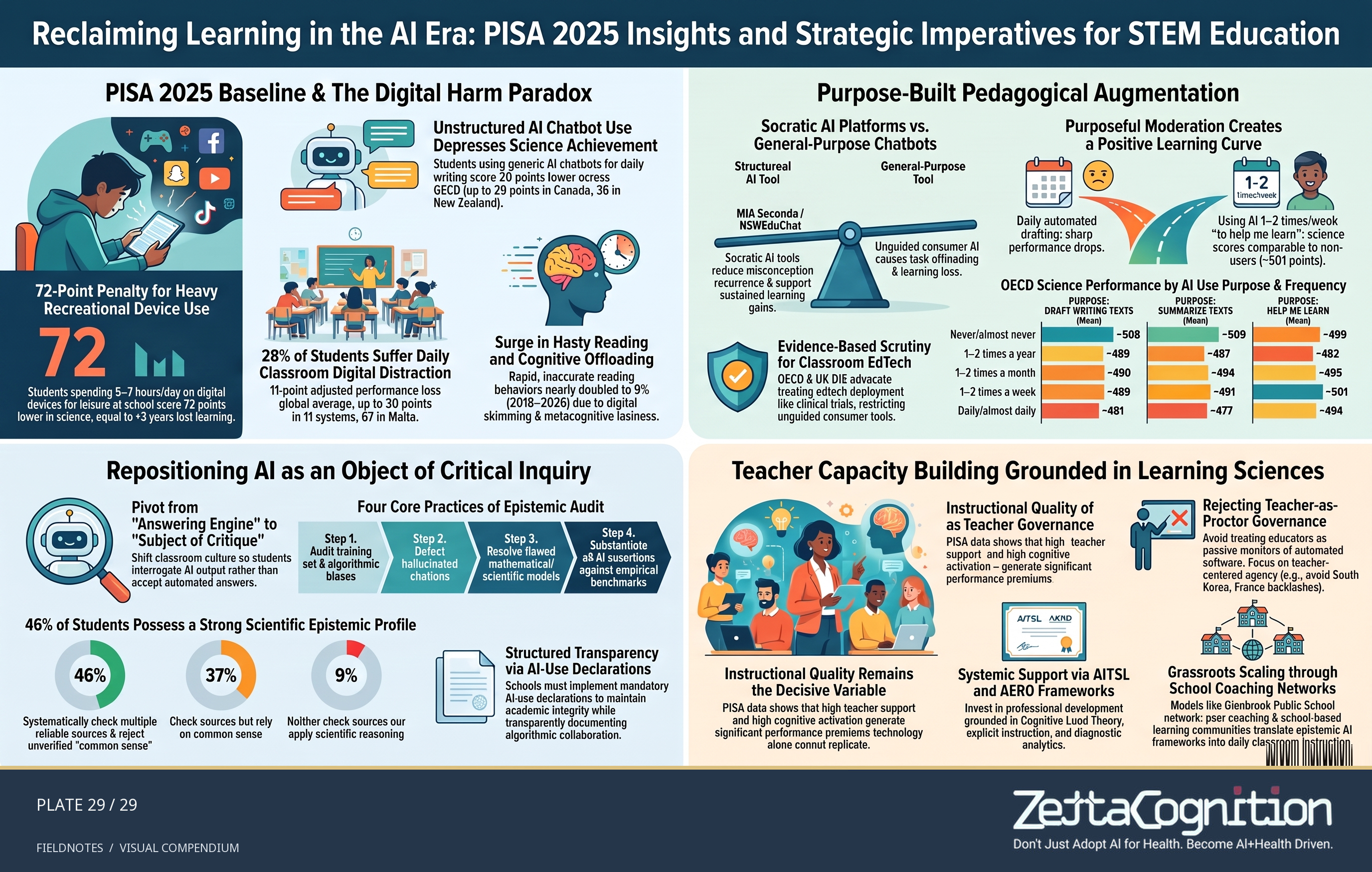
The PISA STEM plate connects critical inquiry, purposeful assistance and teacher capacity. Its score gaps and percentages are unverified source annotations, not statistics endorsed by this journal. Follow the proposed teaching moves rather than using the numbers as a verdict on AI.
Read PISA as a question about capability
PISA assesses 15-year-old students. Its 2025 cycle places science at the centre and introduces Learning in the Digital World as an innovative domain. The published science framework describes three core competencies: explaining phenomena scientifically; constructing and evaluating designs for scientific enquiry and interpreting scientific data and evidence critically; and researching, evaluating and using scientific information for decision-making and action. These are demands for judgement, not simply for accurate recall.
The digital domain brings self-regulated learning and computational problem-solving into the discussion. The useful distinction is between operating an interface and learning through a digital environment: setting a goal, testing an approach, noticing a failure and changing course. A student can be quick with a device and still struggle to decide whether the result makes sense.
The accompanying research artwork contains precise score gaps, percentages and country comparisons presented as PISA 2025 findings. This journal has not independently checked those numerical claims against the underlying tables. They remain visible as part of the original research visuals, but are not adopted here as verified statistics. The NCES schedule lists the main-data release for autumn 2026 and self-regulated learning data for spring 2027; readers should distinguish a framework, a publication timetable and a confirmed result.
Even a verified association between technology use and a score would not establish that the tool caused the difference. Prior attainment, the task, access to support and the reasons students choose a tool can all matter. “AI caused the decline” is a much stronger statement than an observational comparison can support on its own. The educational question is more useful when it stays precise: which design helps which students develop which capability?
Bring the debate back to a single lesson. These five questions help distinguish assistance that develops capability from assistance that simply completes the work. They are an editorial aid, not an official PISA checklist.
Does the tool leave the learning with the student?
- 1Purpose
Name the capability this lesson develops.
- 2Support
Decide which work assistance may take on.
- 3Question
Ask the learner to challenge an AI explanation.
- 4Verify
Test claims against disciplinary evidence.
- 5Transfer
Check understanding on a new task.
Keep the struggle that teaches
The source contrasts cognitive offloading with pedagogical augmentation. Offloading means handing part of the work to an external aid; that can be useful, even necessary. A calculator can release attention for interpreting a model. A text-to-speech tool can make a difficult resource accessible. The problem is not assistance itself. It is removing the very mental activity the lesson is meant to develop.
Consider a mathematics task in which a student must recognise why an algebraic step is invalid. Asking AI to deliver a corrected solution may get the worksheet finished while leaving that recognition unpractised. Asking for a hint, comparing two proposed methods or defending the point at which an argument breaks can preserve the learning. The boundary depends on the objective, the learner and the teacher’s judgement—not on a universal rule that all hints help and all answers harm.
A purpose-built assistant may be designed to ask questions, withhold a final answer or surface a misconception. Those features are promising design choices, not proof of educational effectiveness. Teachers need to check whether students actually reason through the interaction, whether hints remain accurate and whether the capability transfers to a new task. A conversational style that sounds Socratic can still lead a learner through the wrong explanation.
The strongest test comes later. Can the student explain the idea without relying on the generated wording? Can they apply it when the surface details change? Can they notice an error the assistant did not notice? Support during practice and independent evidence of capability answer different questions. Good assessment makes room for both.
Turn the machine into something to investigate
The infographic’s most useful proposal is its set of epistemic audits: examine bias, interrogate a model, verify a citation and compare a claim with evidence. Read these as a teaching design, not a validated intervention. Each audit creates an opportunity for students to make their reasoning observable.
In the hypothetical river lesson, an AI explanation might assume conditions measured in another climate. Students could identify the assumption and compare it with local observations. In a mathematics lesson, an elegant-looking derivation might conceal a unit mismatch. Students could test dimensions before trusting the answer. In a research assignment, a reference might look plausible but be absent from the journal it supposedly names. Students could follow the citation trail rather than accepting its typography as evidence.
These activities keep the disciplinary standards in charge. Scientific claims need observations, methods and defensible interpretation. Mathematical claims need coherent reasoning. An AI response is a candidate explanation, not an authority that suspends those requirements. The source’s phrase “object of critical inquiry” is valuable because it changes the student’s position from recipient to investigator.
A short account of AI use can support that investigation: which tool was used, what was requested, which suggestions were rejected and why? Such a declaration does not prove that the work is authentic or understood. It gives a teacher something relevant to discuss, especially when paired with drafts, a conversation or a fresh problem. Keep the evidence proportionate; a learning record should not become a demand to disclose every private interaction.
The blueprint starts with the teacher
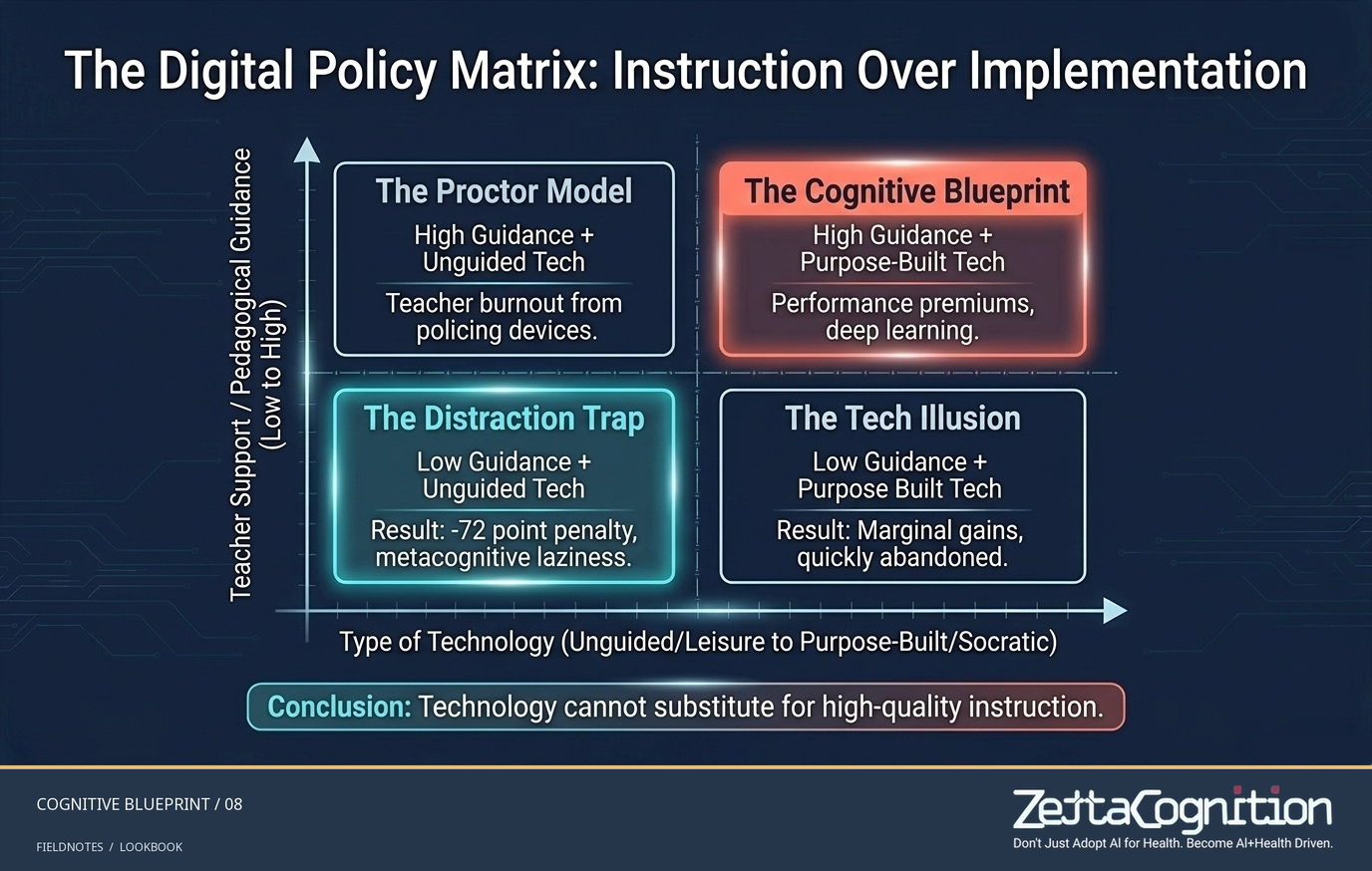
The Cognitive Blueprint slides place pedagogical guidance alongside the type of technology deployed. Their conceptual matrix is a reminder that access to a sophisticated system is not the same as a well-designed lesson. The numerical penalties and country-based gains printed elsewhere in the deck have not been independently verified by this journal; the design argument can be examined without treating those annotations as established effects.
For a school leader, the first investment question should therefore be about teaching capacity. Do staff have time to develop a task, test the tool, anticipate misconceptions and agree on what students must demonstrate themselves? Can they stop using it when it adds distraction or produces unsafe material? A product licence does not supply that professional preparation.
The Australian Framework for Generative AI in Schools offers a public reference point built around teaching and learning, human and social wellbeing, transparency, fairness, accountability, and privacy, security and safety. Those principles need interpretation in local practice. Schools should check current departmental policies, age requirements and data arrangements rather than infer a permission or prohibition from a slide.
Equity belongs in that local decision. Students differ in access to devices, connectivity, language support and trusted adults who can help them challenge an answer. A lesson that assumes every learner can buy the same assistant may widen a gap it was meant to close. Accessible alternatives and teacher support are not peripheral to the blueprint. They are part of whether it works.
Measure what remains when the tool leaves
A school does not need to choose between ignoring AI and surrendering the curriculum to it. It can begin with a bounded lesson: name the capability, decide what assistance is appropriate, ask students to explain their choices and check that understanding survives a new problem. Review the result with teachers and students before expanding the approach.
That review should look beyond how quickly a task was completed. Did a misconception become visible? Did students revise an explanation because of evidence? Could they transfer the idea to a new context? Were some learners helped while others were left dependent on the tool? These are proposed evaluation questions, not claims of outcomes already measured in the source.
The PISA-inspired challenge is ultimately human. STEM education should develop people who can seek evidence, reason under uncertainty and decide when a persuasive explanation is not good enough. AI may support that ambition. It must not become the reason the ambition disappears. The important result is not what the machine produced today, but what the learner can do tomorrow.
The digital policy matrix in the Lookbook maps guidance against the type of technology used. Read its quadrants as a conceptual proposal; the score penalties printed in the source artwork are not verified effects. The useful question is where teacher judgement and independent evidence of learning sit.
Let the machine help with the work. Do not let it become the only one doing the thinking.