Quality assurance that sees today
A retrospective report can explain last year’s risks. It cannot intervene in a problem that is growing this week.

Universities collect signals about enrolment, staffing, assessment and progression every day. Too often these signals remain separated until an annual review assembles them.
A warning in the middle of term
Consider a course where enrolments rise sharply while tutorials remain unchanged. An annual report will eventually describe pressure on teaching capacity. For the students waiting for feedback now, eventual recognition is not enough. A timely signal could prompt a conversation while there is still room to act.
The signal might be a staffing ratio, delayed marking or a pattern of withdrawals. None of these numbers explains itself. A sudden change may reflect a new cohort, a recording error or a real service gap. The system should surface the question and help people investigate, not write the conclusion for them.
This is the difference between continuous assurance and continuous scoring. The former treats data as a prompt for accountable review. The latter risks rewarding whatever is easiest to measure, even when that measure says little about education.
Students and staff should be able to challenge a misleading alert. The definitions behind indicators, the source of the data and the action taken in response must be intelligible to the people whose work is being judged.
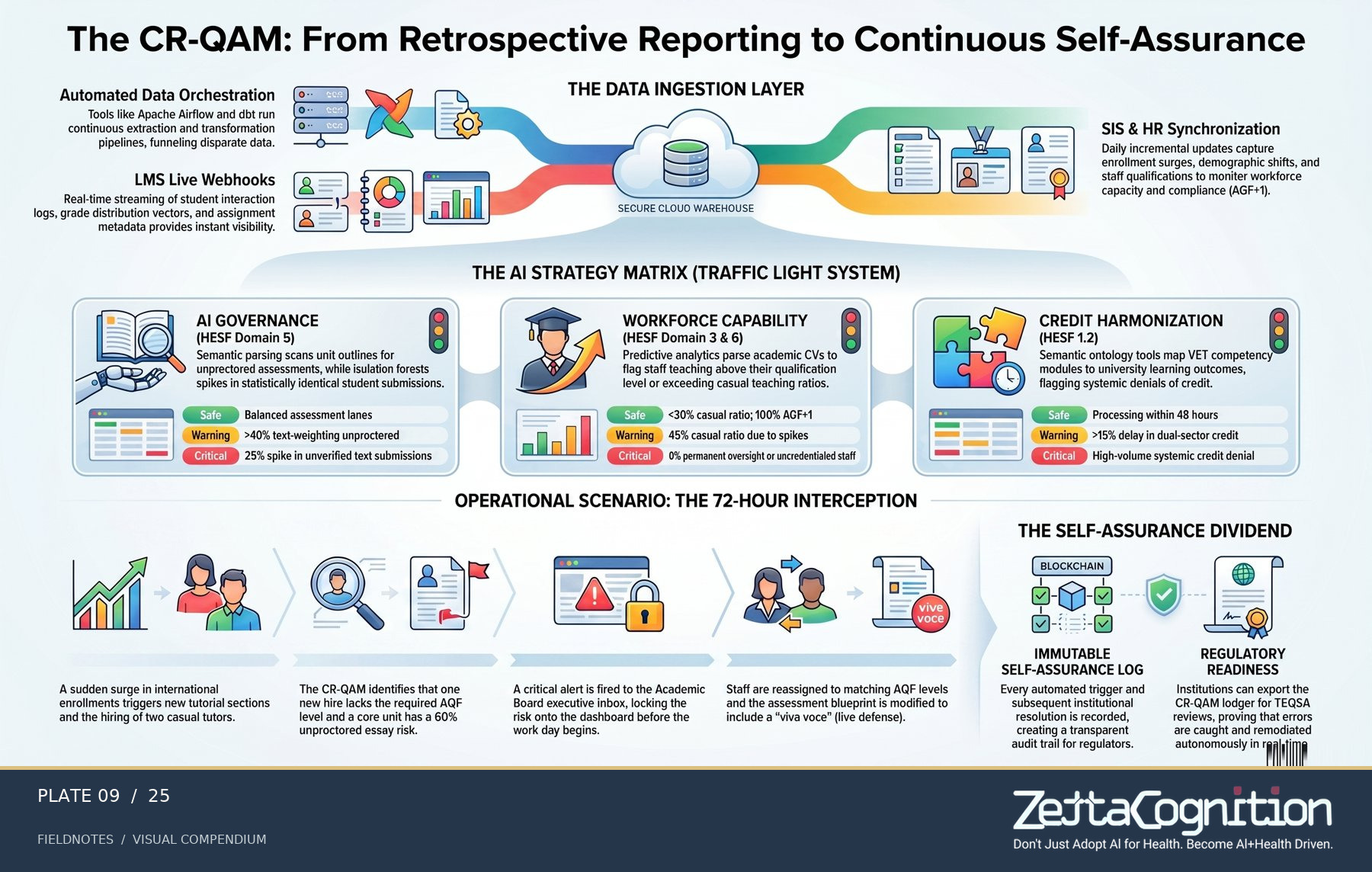
The continuous-assurance plate replaces the once-a-year snapshot with a loop of signals and review. The loop matters only when a person can investigate and act before a problem hardens.
Closing the loop
A useful quality system records not only that a threshold was crossed, but who reviewed it, what context they found and whether an intervention helped. That makes assurance a learning process rather than a parade of red and green lights.
Academic boards need a way to distinguish local noise from a systemic problem. They also need to protect people from the temptation to tidy a metric while leaving the underlying issue untouched. The strongest evidence joins quantitative patterns with lived experience.
Looking sooner should mean caring sooner. The promise of real-time quality assurance is not an all-seeing machine; it is an institution with enough visibility, humility and authority to respond before yesterday’s problem becomes next year’s report.
The comparison below is about timing, not omniscience. More frequent signals are useful because people can question them while there is still time to change the outcome.
Quality assurance that keeps up
Connect the evidence
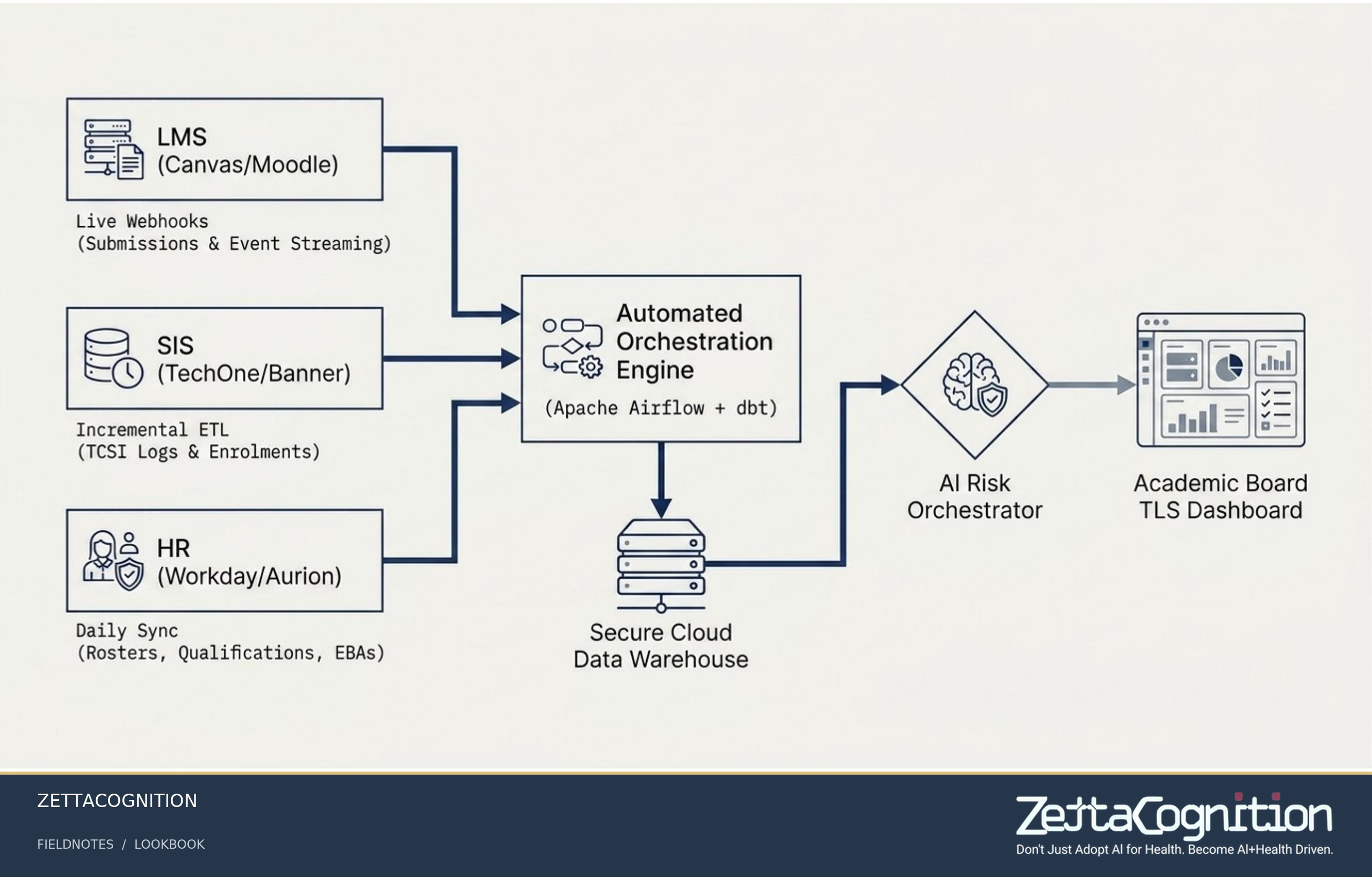
Linking systems can make patterns visible earlier: an unexpected enrolment surge, a shortage of qualified teaching staff or delays in support for a cohort. Early visibility gives people time to ask better questions.
A dashboard should show where attention is needed, not silently declare a course safe or unsafe. Good data can still reflect missing context.
Design for accountable intervention
Thresholds need documented definitions, human review and a route for correcting errors. Otherwise an alerting system can turn messy educational realities into misleading traffic lights.
Continuous assurance is valuable when it helps an academic board act with evidence and care. It is dangerous when the institution mistakes automation for judgement.
The Lookbook flow traces evidence from signals through review to an accountable decision. Treat it as a research proposal: indicators need local definitions and a fair way to correct misleading ones.
The best reason to see a problem sooner is not to score someone sooner. It is to help them sooner.
Cite this story
Sidhu, A. S. (2026). Quality assurance that sees today. Fieldnotes: AI Research Journal, 1(2). https://doi.org/10.5281/zenodo.23329891