The degree as evidence, not assertion
If every subject verifies learning alone, nobody sees the complete picture of what a graduate can do.

A qualification makes a promise that extends beyond any single assignment. Its credibility depends on evidence of learning across the program, not just a collection of passing marks.
A promise made across years
At graduation, a student carries more than a transcript into a workplace. The qualification implies they can combine knowledge, make decisions under uncertainty and meet the standards of a field. Yet a stack of unrelated assignments may reveal surprisingly little about whether those abilities came together.
A program could identify a small number of capabilities that must be evidenced repeatedly. In an early project a learner explains a method; later they apply it in a new setting; near graduation they integrate it with other demands. The sequence matters because growth is not a single score.
The evidence does not have to look identical in every discipline. It may be a clinical demonstration, a defended portfolio, a design critique or a live analysis. What matters is a clear line between the claim made by the award and work a student has actually shown.
This approach also helps locate gaps. If every subject assumes that another subject checks communication or ethical judgement, no one may ever observe it. A shared map makes responsibilities visible without forcing every teacher to assess everything.
The first Compendium plate looks beyond a stack of unrelated marks. Follow the connections between outcomes, teaching and assurance across an entire program.
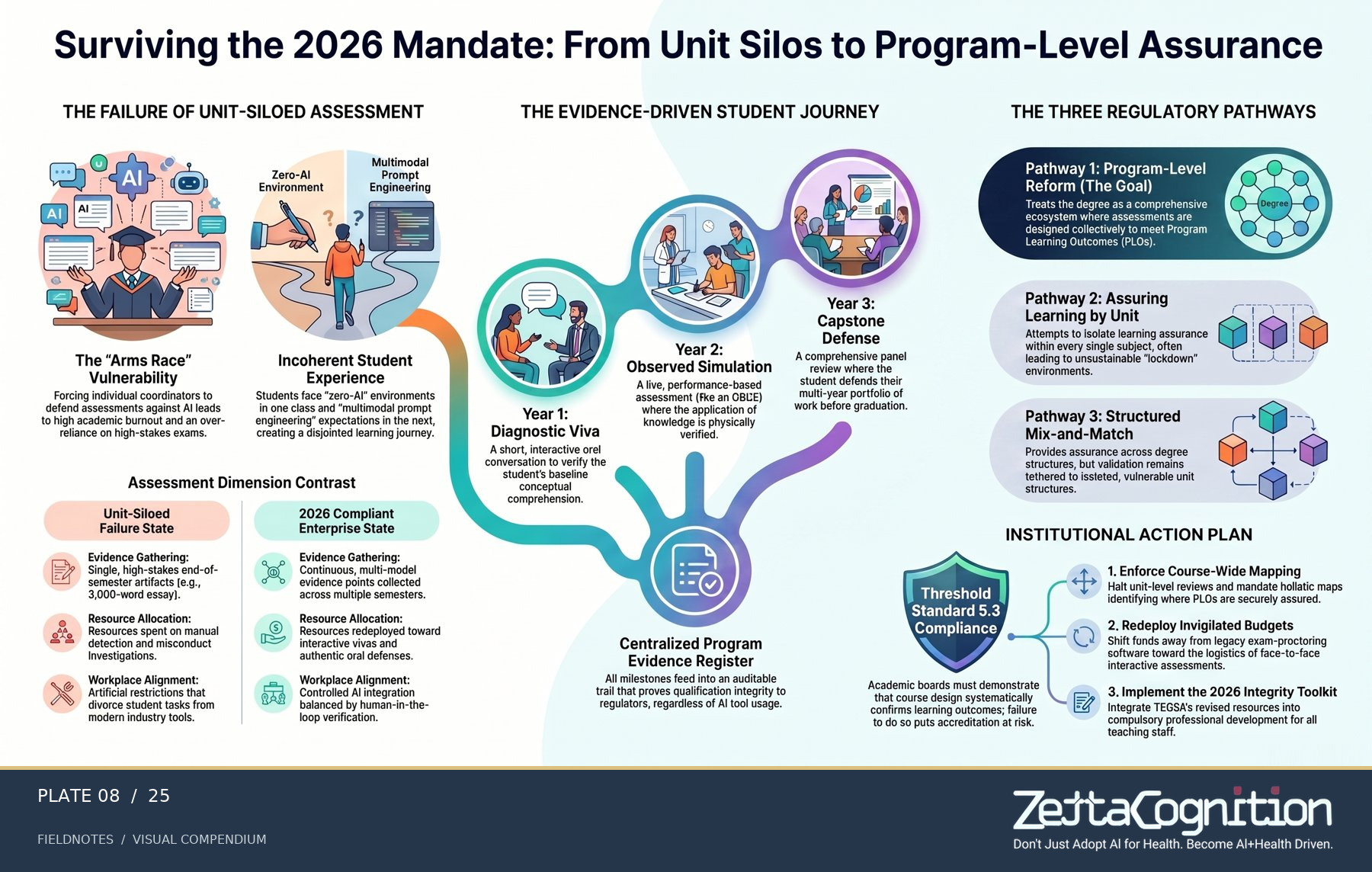
Confidence without constant policing
AI complicates the interpretation of a polished submission. It also makes the program-wide view more valuable. A student can demonstrate independent ability at selected points and learn to work critically with tools at others, leaving a richer record than a blanket ban could provide.
Faculty need time to agree on standards and review examples together. Students need feedback that lets them see how earlier work informs later choices. Employers need an account of capability more meaningful than a list of course titles.
A degree earns trust when its promise can be traced to credible moments of learning. That is a more ambitious project than simply making each assignment harder to cheat.
The four-part map below turns a degree’s promise into something inspectable: define the capability, locate its checks and collect evidence of growth.
A degree as a body of evidence
- 1Outcomes
Define what graduates can do.
- 2Map
Link tasks to those outcomes.
- 3Secure checks
Verify key capabilities.
- 4Portfolio
Show growth over time.
Join the checkpoints
A program can identify the critical abilities graduates must demonstrate and then gather evidence at multiple points: a first-year foundation, a middle-stage practical and a final integrated challenge.
This spreads the burden of assurance. It also reveals whether a learner can transfer knowledge from one context to another rather than repeating a familiar format.
Keep the workplace in view
AI-rich workplaces need graduates who can use tools critically and also recognise when to work without them. Program-level design can accommodate both without making every assessment a surveillance exercise.
The question for institutions is not only whether a student completed a task. It is whether the degree, taken as a whole, has earned the confidence it claims.
The second plate adds the complementary routes to evidence. A supervised checkpoint and a rich portfolio do different jobs; neither should be made to impersonate the other.
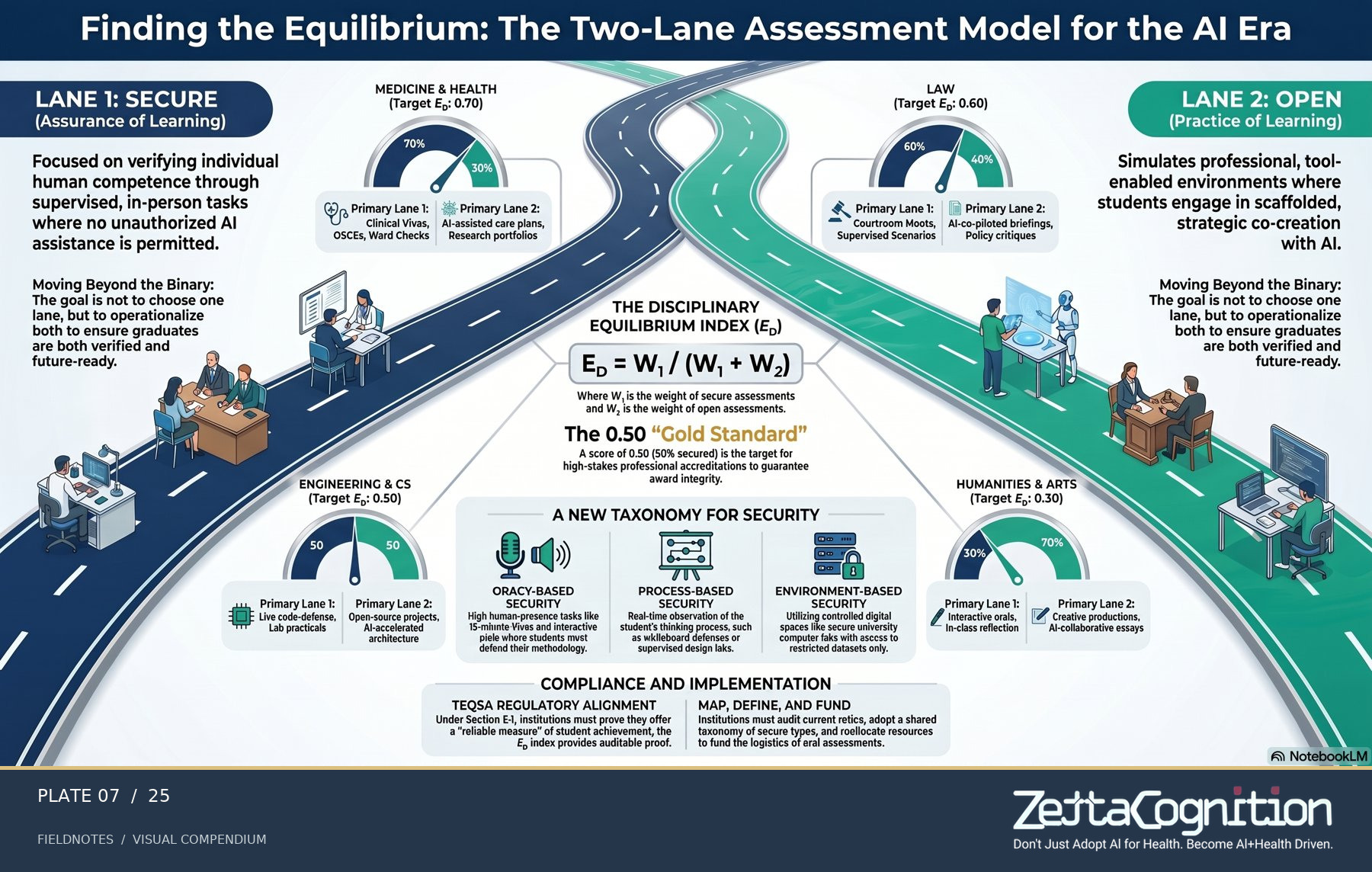
A degree becomes more credible when it can show not just that students passed, but what they learned to do across the journey.
Cite this story
Sidhu, A. S. (2026). The degree as evidence, not assertion. Fieldnotes: AI Research Journal, 1(3). https://doi.org/10.5281/zenodo.23330496