The glass-box mandate: make AI answerable
EdTech and enterprise AI need more than an ethics statement. They need a visible route from data to decision—and someone who can change the outcome.
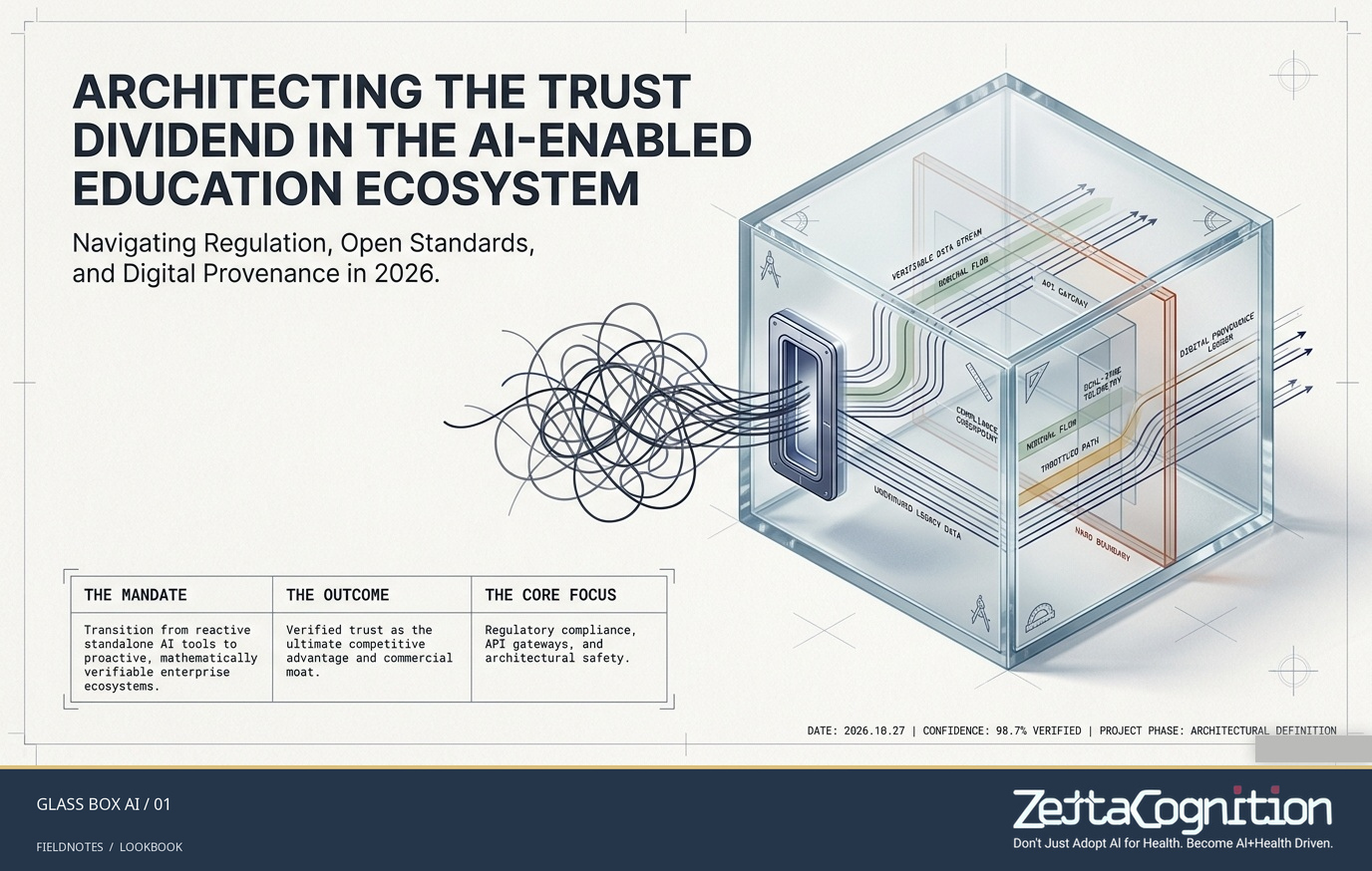
The most revealing question in an AI procurement meeting is not ‘How intelligent is it?’ It is ‘What happens when it is wrong?’ A polished demonstration can answer the first question beautifully while leaving the second untouched. The new research on EdTech, enterprise IT and AI governance argues for a different starting point: build an institution that can inspect the use of intelligence, not merely buy access to it. Call it the glass-box mandate—not one universal law, but a practical demand for answerable systems.
The demo ends. Responsibility stays.
Imagine a university evaluating an assistant that drafts feedback, summarises student records and recommends an intervention. The demonstration is fluent. The room sees shorter queues and more time for teaching. Then someone asks which records left the institution, how long the provider retained them, whether a recommendation can be reconstructed and who handles an appeal. Suddenly the product presentation becomes an architecture conversation. This scene is hypothetical; it illustrates the central tension in Professor Amandeep Sidhu’s policy briefing.
The briefing calls the move from reassuring statements to inspectable controls a shift toward ‘Verification-Based Trust’. The phrase is useful because it asks for evidence. A supplier’s promise not to train on customer data is different from an agreed processing arrangement, a configured control and a record that can be checked. None guarantees that a model will never fail. Together, they make the organisation less dependent on taking reassurance at face value.
For an EdTech vendor, that changes what a convincing product must show. For enterprise IT, it changes what belongs in the integration design. For leaders, it changes the question they should ask before approving deployment: can the institution explain the workflow well enough to correct it?
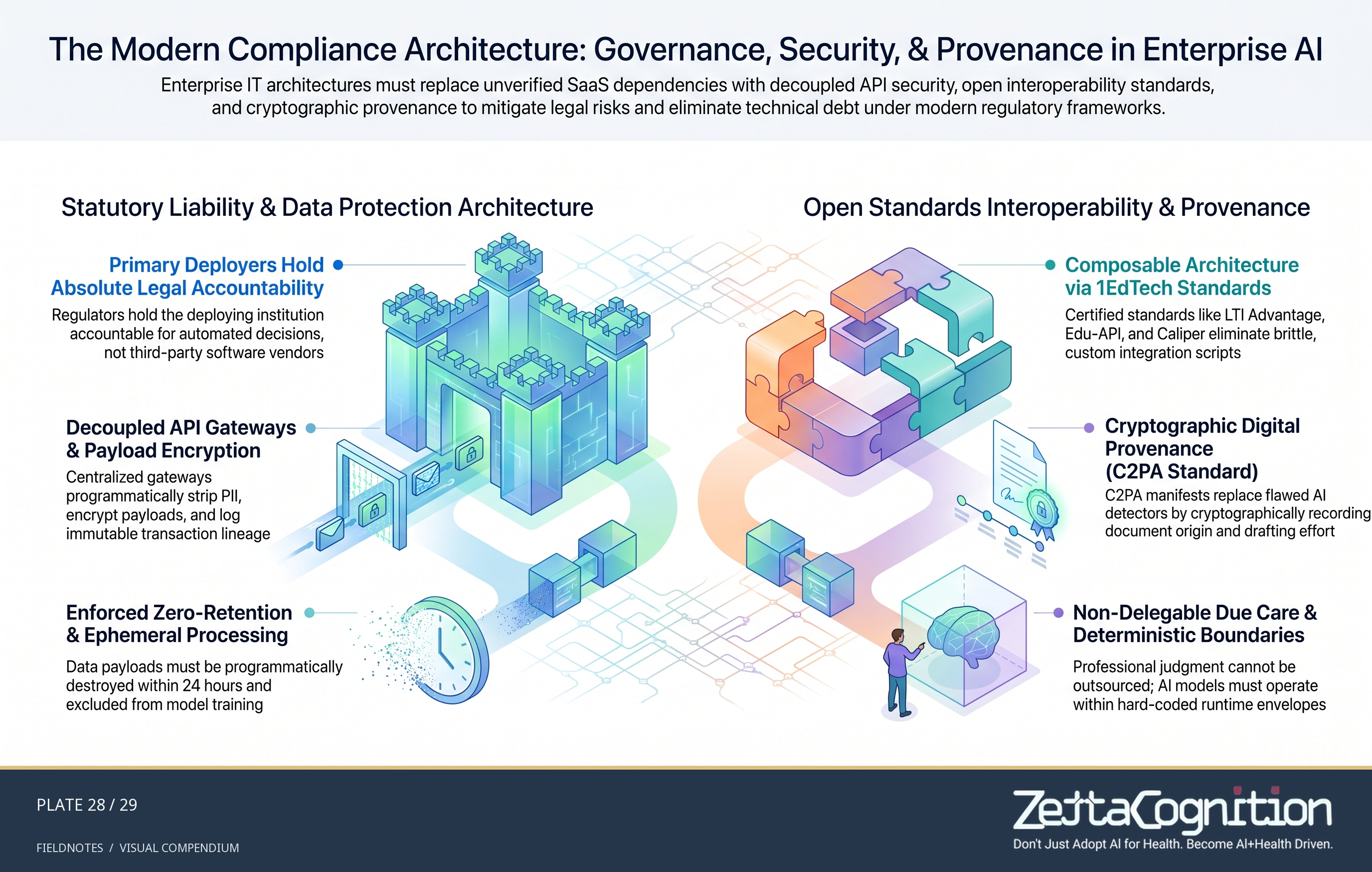
The Modern Compliance Architecture plate brings the proposed controls together. Read it as the author’s strategic illustration: its legal labels and ‘zero-retention’ wording are not a compliance finding. The next section separates the design ambition from the actual disclosure deadline.
A real deadline is not a universal mandate
There is a concrete Australian transparency deadline behind part of this discussion. The OAIC states that new obligations under Australian Privacy Principles 1.7–1.9 take effect on 10 December 2026. For covered entities and qualifying uses, privacy policies must disclose computer programs that make, or substantially and directly inform, decisions that could reasonably be expected to significantly affect an individual’s rights or interests. That is a scoped disclosure requirement, not a blanket instruction that every organisation must install the same gateway or traffic-light dashboard.
The distinction matters. The source bundles privacy, professional responsibility, market conduct and international AI regulation into a single strategic narrative. Those regimes have different subjects, tests and jurisdictions. Its reference to California’s SB 1047 should not be read as current law: that bill was vetoed in September 2024. Procurement teams should check applicable enacted legislation and current guidance rather than copying compute thresholds from a research diagram.
The lesson is not to dismiss architecture because a source overstates a rule. It is to separate the legal obligation from the proposed way to meet a broader operational need. A lawyer can help establish what applies; an architect can show what the system does; a responsible decision owner must connect the two. A confident label is not a compliance assessment.
Translate that distinction into five questions before a purchase. Each question needs an owner and evidence; none is answered by a product badge alone.
Five questions for answerable AI
- 1Scope
Which obligations apply to this decision?
- 2Data
What leaves, stays and trains the model?
- 3Connect
Can we inspect integrations and change providers?
- 4Act
Who can investigate, correct and pause?
- 5Evidence
What explains the outcome without over-collecting?
Put a gateway where the responsibility is
The Modern Compliance Architecture infographic makes the source’s proposed response visible: separate the institution’s data and decision controls from the underlying model service. An institutionally controlled gateway can mediate approved requests, apply access rules and record exchanges. In this design, changing a model provider should not require surrendering the institution’s understanding of how data moves.
That is the attraction of a composable stack. The learning system, student-record system and approved AI tools should not become a knot of undocumented connections. But a gateway is not a magic privacy shield. Sensitive information can remain in prompts, logs, backups or downstream systems. Good design needs a data inventory, defined retention, tested filtering, restricted access and an incident path—not merely a box labelled ‘sovereignty’.
The source also pairs ‘zero-data retention’ with a 24-hour deletion proposal. Those are not interchangeable claims. Leaders should specify what is retained, for how long, by whom, for what purpose and with which exceptions. They should distinguish no model training from no storage, and both from immediate deletion. A contract and a technical configuration need to tell the same story.
Interoperability is a control, not a certificate
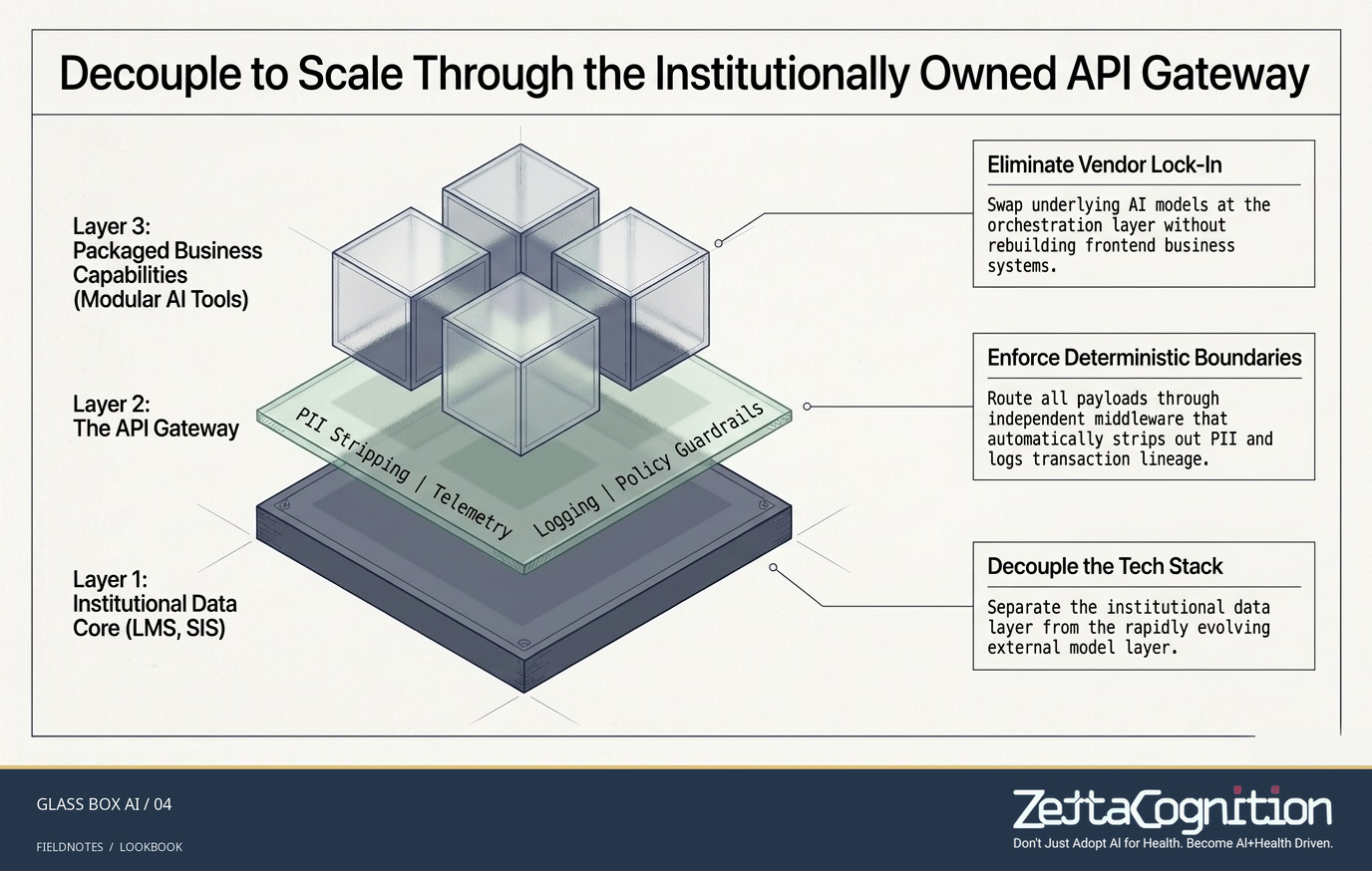
The Glass Box AI slides contrast tangled custom integrations with a decoupled institutional stack. Their most persuasive point is not that custom code is always wrong; it is that brittle handoffs can hide dependencies. When a provider changes an interface or a permission, the institution needs to know what else changes with it.
1EdTech’s standards supply useful connective tissue. Learning Tools Interoperability supports learning-tool integration; EduAPI addresses exchange of core education enterprise data; Caliper Analytics provides a common language for learning-activity events. These are distinct standards with distinct purposes. They can support coherent integration and evidence, but using one does not automatically make a system lawful, secure or educationally effective.
Ask a vendor for the relevant standard, version, implementation scope and, where applicable, independently checkable certification. Then test the local workflow. Can the institution export its records, revoke a connection and change a model without losing essential business context? Portability is valuable because it makes an exit decision possible, not because it promises switching will be effortless.
From traffic lights to a person who can act
The briefing proposes continuous self-assurance: monitor the service while it runs, identify departures from expected behaviour and route them to a response. Its green, amber and red bands are illustrative design choices. The five and fifteen per cent thresholds shown in the visuals are not regulator-approved limits, and a single percentage cannot establish safety across student support, finance and healthcare.
Monitoring only helps when the signal describes a meaningful failure and the response has an owner. A student-support assistant might need to flag unsupported recommendations, disclosure of sensitive information or a mismatch between the source record and the generated summary. A named reviewer needs enough context, time and authority to investigate, correct a record or pause the service.
More telemetry is not automatically better oversight. Collecting every interaction can create new privacy and surveillance risks. Design the minimum evidence needed to explain consequential actions, define who may inspect it and make correction possible. The glass box should make institutional decisions accountable; it should not turn people into permanent observation targets.
Provenance is evidence—not proof of learning
The source’s fourth pillar moves away from guessing whether a finished text looks machine-written and toward evidence of how work developed. That is an important direction for education. A student’s draft, discussion, revision and explanation can tell a richer story than a detector score. But evidence must be relevant, proportionate and open to challenge.
C2PA provides a technical framework for tamper-evident assertions about the origin and history of digital content. It is not a certificate that a human wrote an essay, that the content is true or that the student understands it. An absent credential does not prove misconduct, and a present credential does not settle an assessment decision. Provenance can inform judgement; it cannot replace it.
The briefing also argues that Indigenous knowledge must not be treated as simply another input available for model training. Technical boundaries can support restrictions, but they cannot manufacture consent or cultural authority. Decisions about collection, access and reuse need to be made with the people entitled to make them. The most sophisticated gateway cannot substitute for that relationship.
Buy the ability to answer back
The glass-box idea does not require every model’s internal reasoning to become fully transparent. It asks for something an institution can more realistically govern: the inputs it permits, the actions it authorises, the evidence it retains and the people empowered to question an outcome. That is transparency around the use of a model, not a promise to see inside every weight.
For vendors, the opportunity is to make these controls demonstrable rather than bury them in a policy document. For enterprise IT, it is to keep integration and exit paths legible. For education leaders, it is to protect the learning and professional judgement that automation is meant to support. The source presents procurement speed and commercial advantage as potential benefits of trust; this story does not treat them as measured outcomes.
The next procurement meeting can begin with a small rehearsal: trace one sensitive request from source data to final decision, introduce an error, then show how the institution notices, intervenes and explains what happened. If the team cannot perform that rehearsal, the demo is not finished. The most valuable AI system is not the one that never gets questioned. It is the one built to survive a good question.
The Glass Box AI frame returns to the institutional gateway and decoupled stack. It illustrates how local control could be preserved while providers change—not a guarantee that a gateway makes every exchange safe or lawful.
Do not buy a black box and outsource the consequences. Buy the ability to inspect, intervene and answer back.