Two lanes for assessment
Students need room to use contemporary tools—and moments when they must demonstrate what they can do themselves.
The debate over AI in assessment is often framed as a choice between locked-down exams and unrestricted take-home work. Neither extreme tells the whole story of competence.
Two different kinds of confidence
A student might use an AI assistant to explore a design brief, compare options and draft a recommendation. In an open task, the educator can ask which suggestions the student rejected and why. That is a demanding form of learning, but it does not by itself establish what the student can do when a tool is unavailable.
A separate live challenge can answer that narrower question. The student explains a principle, performs a procedure or responds to an unfamiliar problem in their own words. Neither experience needs to impersonate the other. Together they give a fuller account of competence.
The design becomes harder when every subject chooses its own rules. Students can face an unpredictable patchwork of permissions, while staff struggle to know what has already been verified elsewhere. A program-level map can distribute the work across a degree.
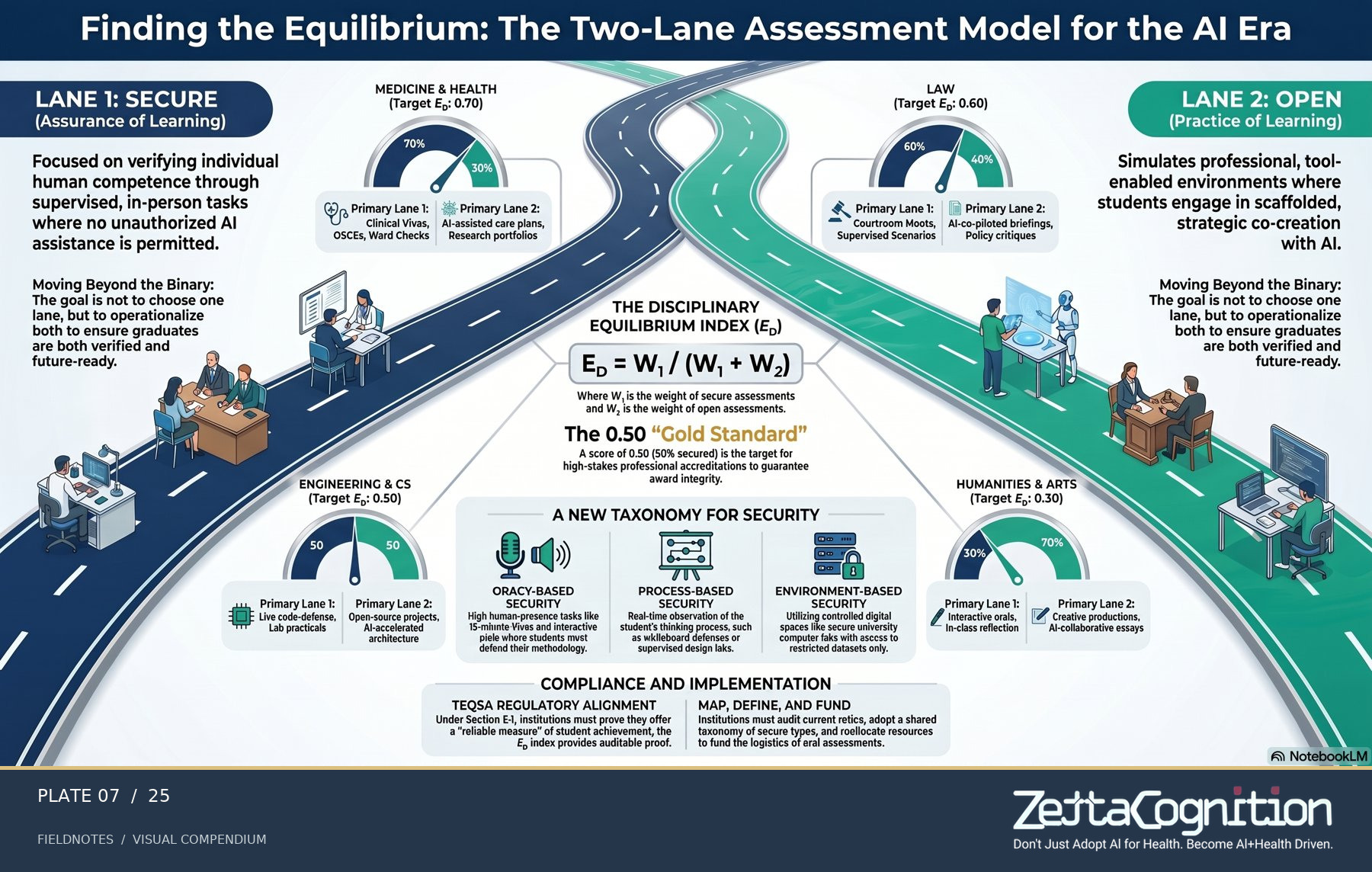
That map should make the rationale explicit. What must a graduate perform independently for safety or professional trust? Where is responsible use of contemporary tools part of the work itself? The answers will vary across disciplines and tasks.
The two-lane plate makes a useful distinction visible: working independently and working well with tools are both abilities, but they are not the same test.
A fairer bargain for students
Security is not synonymous with a high-stakes exam. A supervised practical, an oral explanation or a sequence of observed decisions may better fit the skill. Open work, similarly, should not become a vague permission to submit an unexamined machine output.
Students deserve to know the purpose of each mode before assessment begins. If they understand why an independent checkpoint exists and how an open task values their judgement, the rules become part of the learning design rather than an ambush.
The aim is a degree that can say two things honestly: this graduate can act when their own capability matters, and this graduate can use powerful tools without surrendering their judgement.
Read the lanes side by side. The secure lane establishes what a learner can do unaided where it matters; the open lane asks them to justify choices in the world they will actually work in.
Two lanes for assessment
Assure and practise
A secure assessment can establish individual capability through a supervised practical, oral explanation or live problem. An open task can ask students to collaborate with tools, evaluate their outputs and work as they would in a profession.
These modes answer different questions. One asks whether the learner can act independently when required; the other asks whether they can exercise judgement amid real-world resources.
Balance by discipline
A nursing program may need live clinical checks; a design program may need documented iterations and a studio critique. Imposing one universal proportion of secure and open work would overlook what each profession must verify.
The right balance belongs at program level, where educators can see the full journey rather than forcing every subject to defend itself in isolation.
The assessment slide returns to the balance between those purposes. No single ratio will serve every discipline; the design must follow what the profession needs to trust.
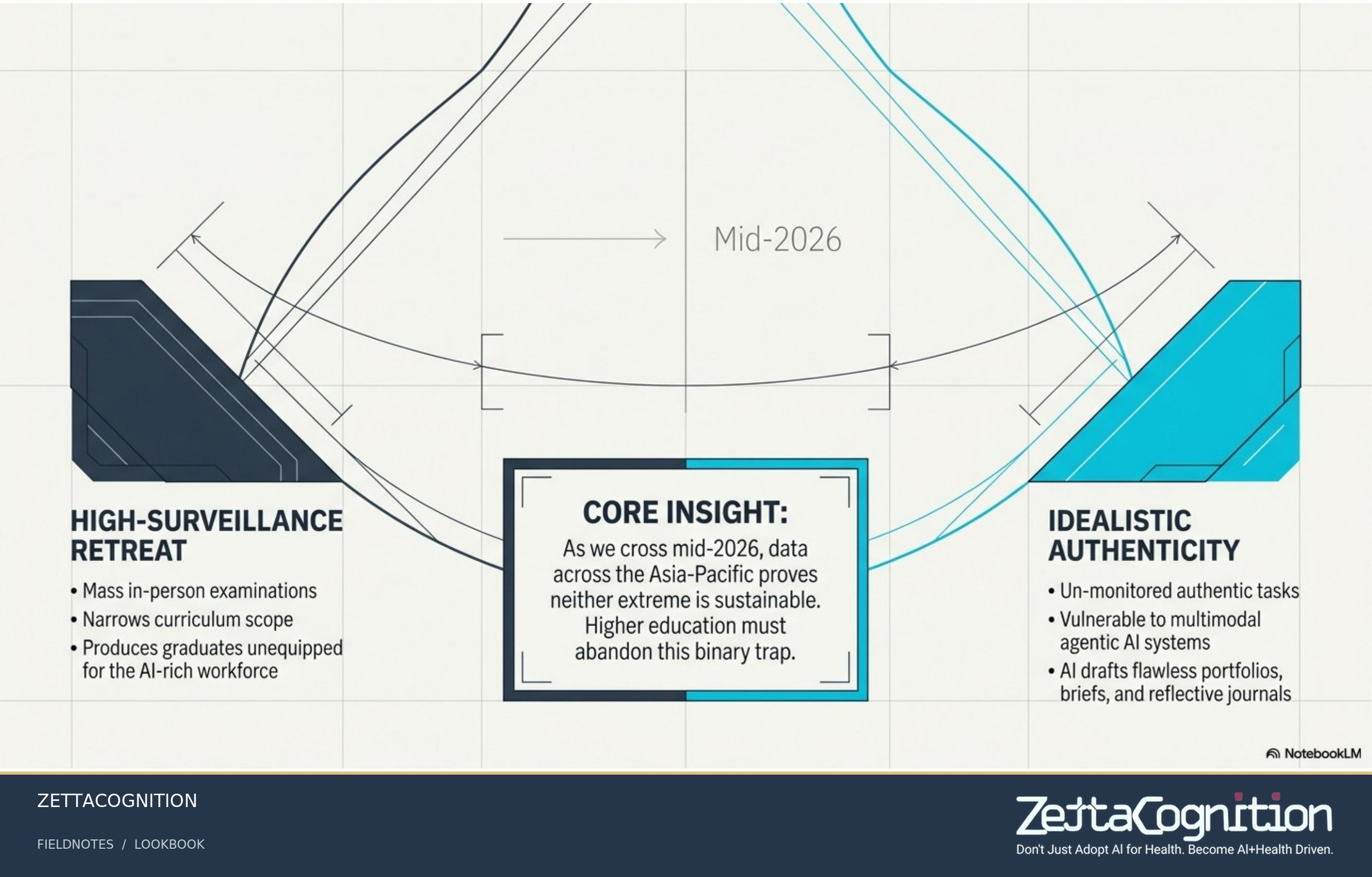
The strongest degree can say two things at once: this graduate knows how to stand alone, and knows when—and how—to use help.
Cite this story
Sidhu, A. S. (2026). Two lanes for assessment. Fieldnotes: AI Research Journal, 1(3). https://doi.org/10.5281/zenodo.23330626