When curriculum expires faster than a degree
AI has shortened the distance between what students learn and what the world asks them to know.

A degree takes years to earn. The tools and practices around it may change in months. That mismatch is becoming harder for students, educators and employers to ignore.
A syllabus meets the present
A student might enter a course expecting to learn the tools used in a profession and discover that its central examples describe a workplace already changing around them. The concepts may still be sound; the practice tasks can feel like a time capsule. That tension is increasingly familiar in fields reshaped by generative AI.
For a lecturer, responding is not as simple as adding a new tool to next week’s slides. A change in professional practice can unsettle the learning outcomes, the assessment and the support staff need to teach it. Rapid revision without a clear purpose merely replaces old examples with newer, equally temporary ones.
The more useful distinction is between what a graduate should retain and what should remain adaptable. Critical reasoning, disciplinary knowledge and ethical judgement are enduring aims. A particular software interface is not. Curriculum systems need to treat those layers differently.
Students can help identify the gap, but their feedback should be interpreted alongside evidence from employers, professional bodies and teaching teams. The loudest trend is not always the most important capability.
The compression-of-relevance plate gives shape to a familiar frustration: the pace of change in practice is not the pace of change in a course handbook. That gap need not force a choice between speed and standards.
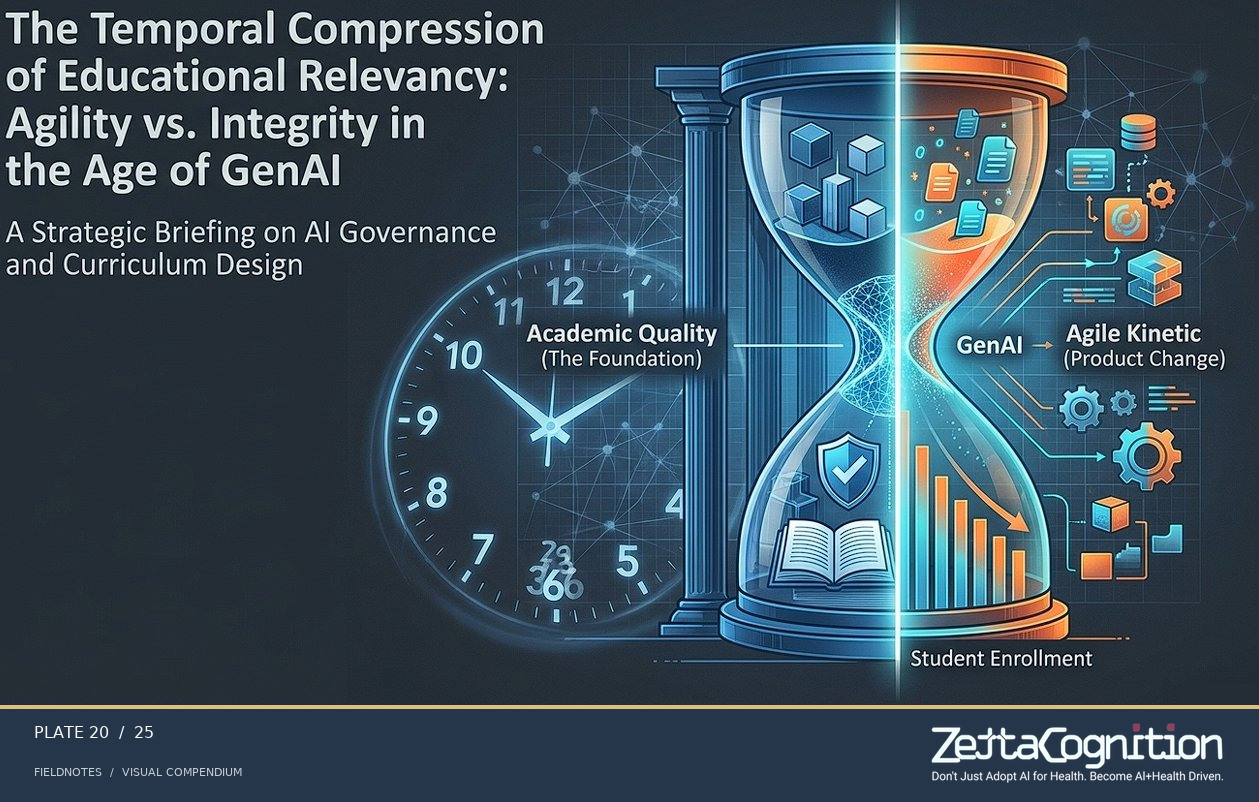
Designing for renewal
A course can make room for current cases and tools inside a stable framework of outcomes. That gives educators permission to refresh the lived examples while still showing an academic board how quality is protected. A review cycle becomes a rhythm of improvement rather than a crisis response.
This also changes the promise made to students. A degree cannot guarantee that every tool taught in first year will remain current at graduation. It can teach students how to learn a new one, judge its claims and understand when established principles still apply.
Relevance is not a finish line reached at accreditation. It is a recurring responsibility shared by the people who design, teach, study and employ from a program.
Here is the renewal loop in four moves. The fixed point is what graduates must be able to do; the movable parts are the cases, tools and exercises that help them get there.
Keeping a course relevant
- 1Listen
Students and industry flag what has drifted.
- 2Separate
Keep outcomes fixed; mark content as changeable.
- 3Update
Refresh cases, tools and practice tasks.
- 4Check
Confirm the standard is still met.
Separate standards from content
Academic quality should remain a durable commitment: clear outcomes, sound pedagogy and credible assessment. But the examples, tools and technical practices used to reach those outcomes need a faster route to revision.
When every small curriculum update must travel through the same process as a new award, institutions can preserve yesterday’s content in the name of quality. That is not the same as protecting standards.
Make relevance a recurring decision
Students and industry can provide early signals about where a course has drifted. Short review cycles can translate those signals into updated case studies, practice tasks and tools while keeping program outcomes stable.
The challenge is not to make education chase every novelty. It is to build a system capable of distinguishing lasting capability from a passing interface.
The clock is not the same as the standard
In his AI Thought Fog newsletter, Professor Sidhu frames the pressure as a tension between agility and integrity. A course can renew its cases, tools and practice tasks on a shorter cycle without treating the standards behind an award as disposable.
That distinction matters for educators asked to teach a changing profession: a faster syllabus is only worthwhile when students can still see which capabilities the degree promises to assess, and how those capabilities were demonstrated.
The agile curriculum slide asks what an institution must make possible for that loop to repeat. Refreshing a syllabus once is easy; making renewal routine is the deeper reform.
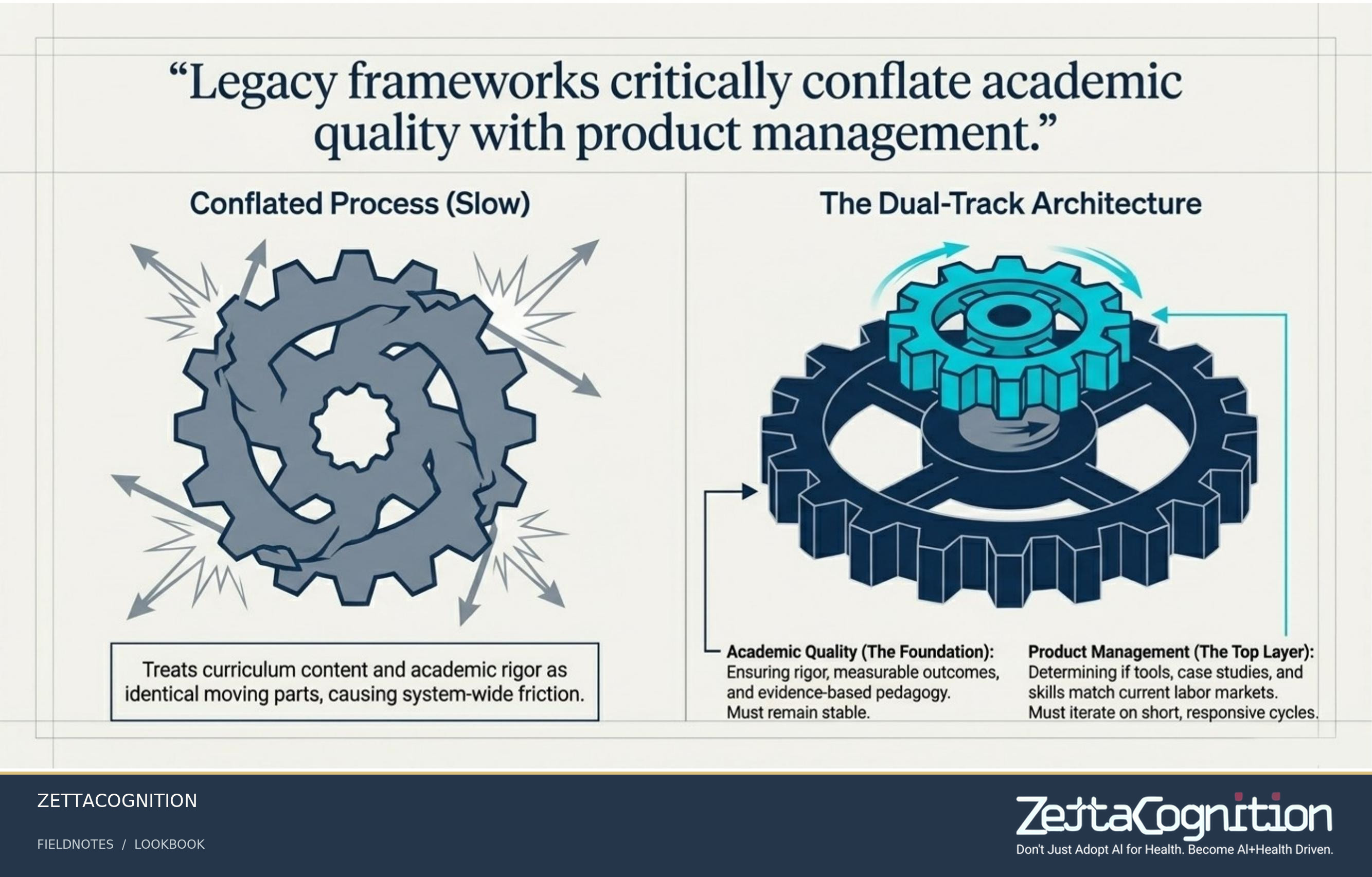
A degree should not promise yesterday’s tools forever. It should promise the capacity to learn, judge and keep up when those tools change.
Cite this story
Sidhu, A. S. (2026). When curriculum expires faster than a degree. Fieldnotes: AI Research Journal, 1(3). https://doi.org/10.5281/zenodo.23330806